

Assessment that plans tomorrow’s lesson.
Built inside your core curriculum, Atlas knows your students and maps your next move.
Schedule your Atlas demoAtlas closes the loop between assessment and instruction.
Assessments reveal what students know and where they need support
or a challenge. Atlas identifies what's next, and builds small groups
and warm-ups all inside your core math curriculum.

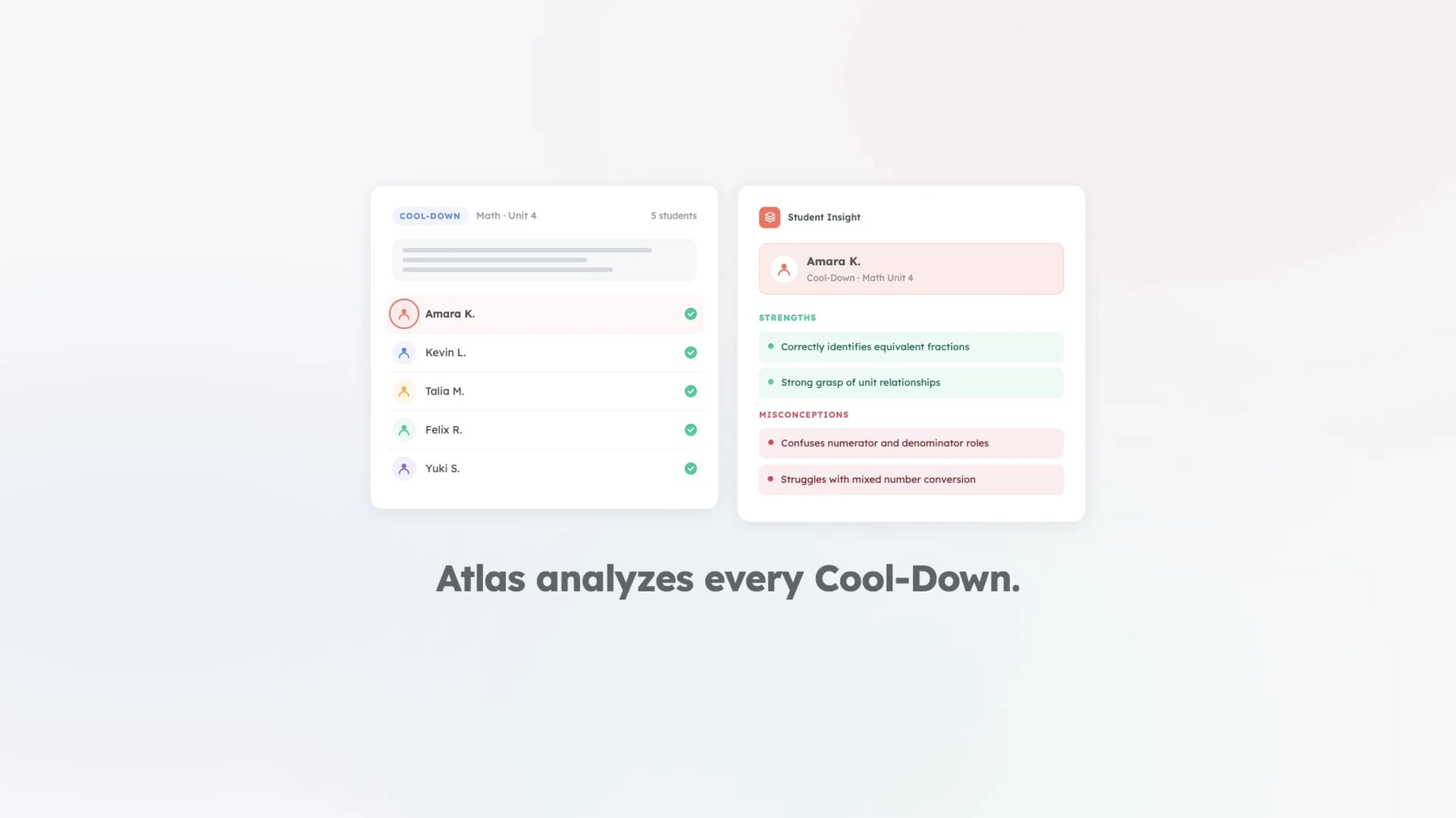

View misconceptions by class and by student.
Atlas builds student groups automatically.
Atlas prepares warm-ups for student groups.
One system. Three levels of support.
and prepares curriculum-aligned next steps. Every student gets the right support
at the right moment, in one connected system.
Teachers know where each student stands

Students remain on
grade-level

Interventionists know exactly where to focus

Students ready to advance get a plan too.

Teachers using Atlas gave students six months of additional learning in one year.
Read the Case Study20%
6mo
Built for everyone who shapes learning.
See the patterns faster.

Know which room needs you most.

September data instead of April surprises.

Trusted by education experts.


Your data.
Your curriculum.
Your decisions.
Atlas reads student work inside a closed system, grounded in your adopted curriculum.
Teachers remain in control
- Review and modify any student group
- Override any recommendation at any time
- Professional judgment stays at the center
Your data stays protected
- Districts own the data
- Atlas runs in a closed environment
- No student PII used in any analysis model
- Student data anonymized before analysis
- Full compliance with FERPA, COPPA, and state privacy laws
Why districts choose Atlas.
Other Assessment Tools
A separate login or add-on bolted onto your curriculum.
A data dashboard.
A diagnostic tool that displays student progress.
Student groups and recommendations to address learning gaps.
A benchmark assessment generator.
A generic AI assistant trained on the open web.
A rigid structure that only follows the program’s cadence.
No new login or separate tool to manage.
Data that takes action. Atlas gives teachers the next step, not just the numbers.
A system that surfaces whole-class and student misconception data inside your curriculum.
Small groups built with targeted warm-ups matched to each student's needs.
Customizable assessments in the unit or lesson you're teaching, not just a periodic check-in.
Only reads your adopted core curriculum, grounded in the standards you teach.
Make Atlas yours. Edit groups, warm-ups, and pacing at any time for your classroom and your students.
Frequently asked questions
Product Overview
What is Atlas?
Atlas is a learning intelligence layer built inside of your core curriculum. It analyzes daily student work, identifies misconceptions, groups students, surfaces next steps, and builds differentiated materials for the next lesson. Instead of showing more data, Atlas helps teachers make data-based choices about what to do tomorrow, faster and with more confidence.
What problem does Atlas solve?
Teachers already have plenty of data. What they don't have is time to turn that data into a clear plan before the next lesson. Atlas looks at student work, shows what students missed, and points teachers to instructional supports for tomorrow that connect directly to today's learning. The result is less planning and more teaching.
Who is Atlas for?
Atlas is for districts that want to strengthen core instruction with a coherent system that uses formative data to reveal the best path forward while keeping teacher agency at the center. It supports responsive teaching, reduces planning burden, and fits naturally within core curriculum and MTSS frameworks.
How Atlas Is Different
What makes Atlas different from other AI or adaptive tools?
Atlas is not an adaptive, student-tracking platform. Atlas shows teachers where students are and what options are available next, but it never moves without the teacher.
Is this the same as using ChatGPT with my students' data?
No. Atlas runs in a closed system built only from your approved curriculum. It doesn't pull from the open internet, and it never sends student data outside that system or trains an outside model. Every suggestion still goes through you before it reaches a student.
Teacher Control & Judgment
Does Atlas replace teacher judgment?
No. Atlas does not make instructional decisions for teachers. Atlas shortens the time between when teachers see student data and when they can provide support. Atlas connects what students missed today to intervention supports for tomorrow, which teachers previously had to do on their own.
Can I change who's in each group?
Yes. Atlas builds the groups first, but you can move a student into any group, give a second attempt, or adjust a grade by hand. Atlas gives a recommendation. You make the final call.
Classroom Workflow
How do Do-nows and Cool-downs fit into instructional time?
A Cool-down is three questions tied to the day's lesson. With Lesson Clipper, Do-nows are simple to assign and manage, and take 5 to 10 minutes, about the same as a typical warm-up.
Every student gets one. If Atlas doesn't find a misconception to address, you can stick with your usual warm-up instead. Atlas still surfaces patterns even on days where a Do-now isn't fully completed, so a spotty week doesn't cost you the insight.
Does the Do-now replace my warm-up?
You decide. Atlas can run before your usual warm-up, in place of a shorter one, or as a bell ringer, transition activity, or small-group check-in. The rest of your lesson stays exactly as planned.
What about custom assessments?
Atlas supports automated scoring and feedback on custom Cool-downs and Do-nows, giving teachers usable insights regardless of whether the content was prebuilt or teacher-created.
What if devices aren't reliable in the classroom?
Atlas is designed to support classroom workflows that don't require constant device interaction, such as discussion-based instruction, small-group work, and shared-device workflows.
Differentiation & Instructional Use
How does Atlas support differentiation without creating more prep work?
Atlas uses patterns in student work to surface activities that already exist within the core curriculum directly in tomorrow's lesson. Teachers don't need a separate planning space or extra tools, and they don't need to hunt for resources. The result is less time rebuilding plans and more time teaching.
Can Atlas insights be used across lessons?
Yes. Teachers can jump between Atlas-leveraged lessons so insights from one day can inform instructional decisions for any upcoming lesson, keeping instruction coherent rather than siloed.
Is Atlas only for intervention blocks?
No. Atlas is designed to inform core instruction first. Teachers can extend its use into intervention time if desired, but its primary value is keeping daily lessons connected and responsive to student work.
Availability & Access
When will Atlas be available?
Atlas is available for the 2026–27 school year. Contact us to schedule your district's implementation.
