Kiddom
December 22, 2025

As AI becomes more present in schools, teachers and leaders are asking the right questions: How does it work? What does it do with student data? And most importantly… who’s really in control?
These questions matter because trust is foundational to any classroom. At its best, AI helps educators by streamlining time-consuming tasks and offers insights about student learning. But not all AI is built the same, and not all of it belongs in the classroom.
Most educators have seen or used general-purpose tools like ChatGPT, or education AI wrappers. These can be helpful for quick tasks like drafting a worksheet or rewording an objective. But tools like these aren’t built with instructional context in mind. They don’t know what curriculum your classroom uses, how your students have performed over time, or how today’s lesson fits into a long-term learning arc. These tools also aren’t at the point of use; they're cumbersome to integrate into the data and reporting system. Furthermore, they require constant prompting, fact-checking, and adaptation. At best, they’re time-saving helpers. At worst, they can introduce inaccuracies, bias, or confusion, and produce content that adds more noise than value.
That’s why purpose-built classroom AI must operate differently. Tools must be grounded in approved instructional materials, not in scraped content from the internet. This means closed models constrained to HQIM, not open models that invite hallucinations. They must serve teachers, not the other way around. They must be designed for education, not adapted to it. They are more than just a chatbot that steamrolls your thinking in favor of mass-predictive text outputs.
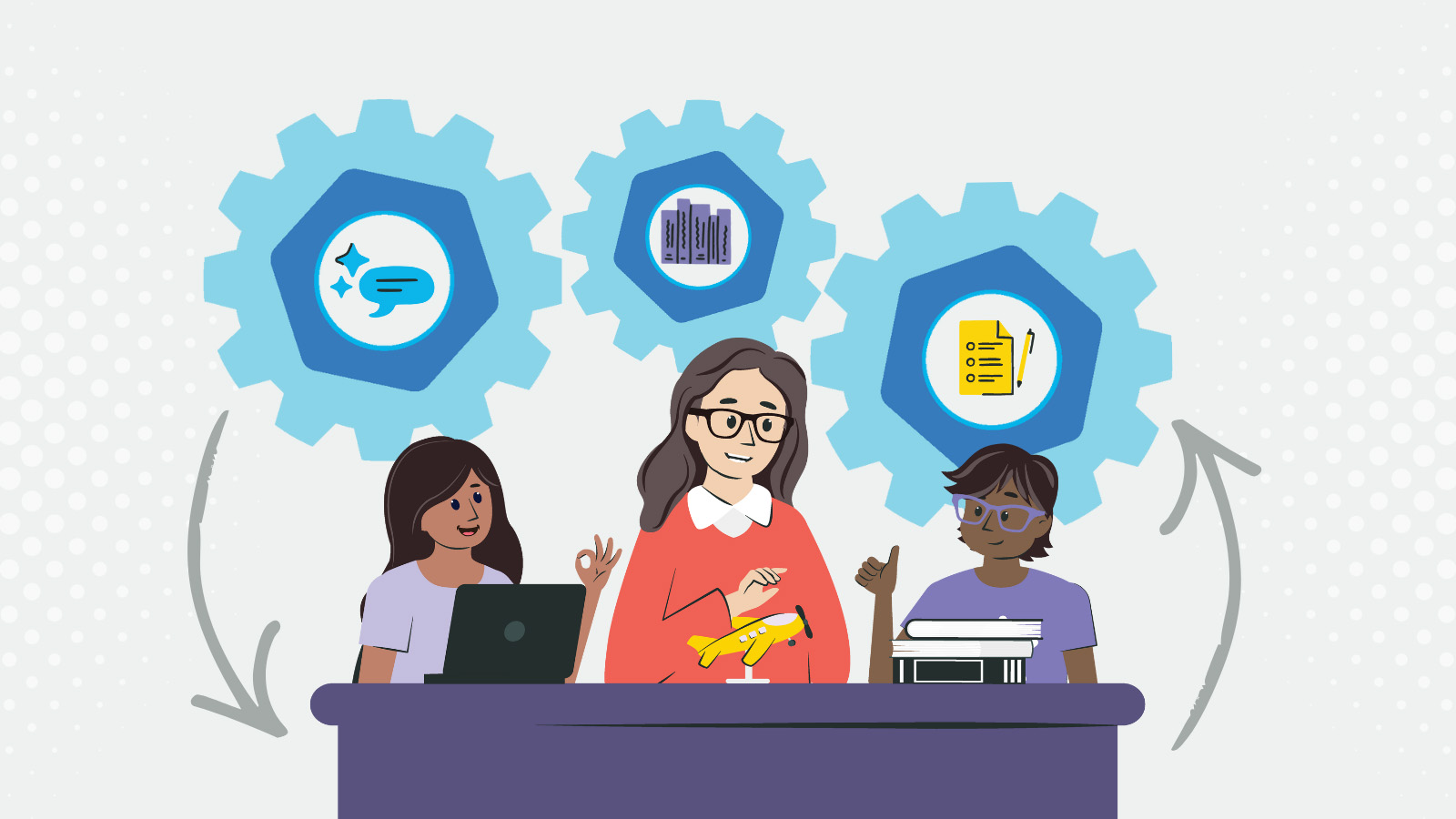
In contrast to generalized models, classroom AI done right works quietly in the background. It knows the standards, the curriculum, and the lesson goals. It can help teachers generate tiered practice problems or suggest feedback, but only after the teacher has reviewed and approved it. It can react to a student’s current progress. Nothing goes to a student without the teacher's say-so. And perhaps most importantly, it does all of this without knowing who the student is.
Teachers are not replaced by this kind of AI. They are empowered. AI may help shorten a lesson, grade a response, or suggest next steps, but only the teacher decides what’s assigned, what’s shared, and what’s taught. That’s because AI can suggest. But only a teacher can see the spark in a student’s eye, or the anxiety behind a blank stare. Only a teacher knows when to pause the plan and lean into connection. The human relationship is, and always will be, the center of learning.
This is the promise of educational AI that’s grounded in respect—for privacy, for professionalism, and for people. It’s not just about doing things faster. It’s about making space for teachers to do what they do best: teach, connect, and care.
This isn’t a future wish. It’s now. It’s Kiddom AI.
Kiddom’s Commitment to Privacy and Safety
Your school owns all student data, and Kiddom protects it with strict safeguards. We separate personally identifiable information (PII) from all learning activities. PII is never used to train our AI models. Instead, students are assigned anonymous IDs, and only anonymized curriculum and performance data are used to power insights and support learning. AI tools are designed to help teachers, not to collect or share personal data. Any reports containing PII stay completely separate from AI features. Our commitment is simple: protect student privacy and use data only to support teaching and learning.