
Hold It, Draw It, Write It: The CRA Model Inside Kiddom Math

What the concrete-representational-abstract (CRA) model is, why it works, and how Kiddom Math lessons move students from cubes to drawings to 24 ÷ 8.
Kiddom logo
Kiddom
September 28, 2026

Knowing the steps is not the same as knowing the math

Ask a third grader what 24 ÷ 8 means and you will often hear how to do it. Divide. Get 3. Ask what the 3 is, and the room goes quiet. The student can run the procedure but has nothing to attach it to. Most of us carry a version of this. We can still recite part of the quadratic formula. Fewer of us can say what it finds, or picture the arc of a thrown ball that it describes.

In plain terms The concrete-representational-abstract model, usually shortened to CRA, is a way of teaching mathematics in three connected stages. Students first work with physical objects, then with drawings and diagrams that stand for those objects, and finally with numbers and symbols alone. Each stage keeps the meaning of the one before it, so the symbols still point at something real.

Kiddom Math is built this way. The lessons inside it move students through all three stages, usually across one section of a unit and sometimes inside a single activity. This post explains the model, the research behind it, and where you will see it in a Grade 3 section on division.

Think of an apple

You can hand a class an apple in three ways. A real apple. A drawing of an apple. The word apple on a piece of paper. Each one carries less information than the one before it.

The real apple has flavor, smell, texture, weight, a stem, a soft spot on one side. The drawing keeps color and shape, but a child who has never held an apple cannot tell from a picture how heavy it is or how big. The word carries nothing on its own. It works only because you already have the apple, or the drawing, in your experience. The symbol borrows its meaning from what came before it.

The same idea, three ways, for an apple and for division

ConcreteThe thing itself
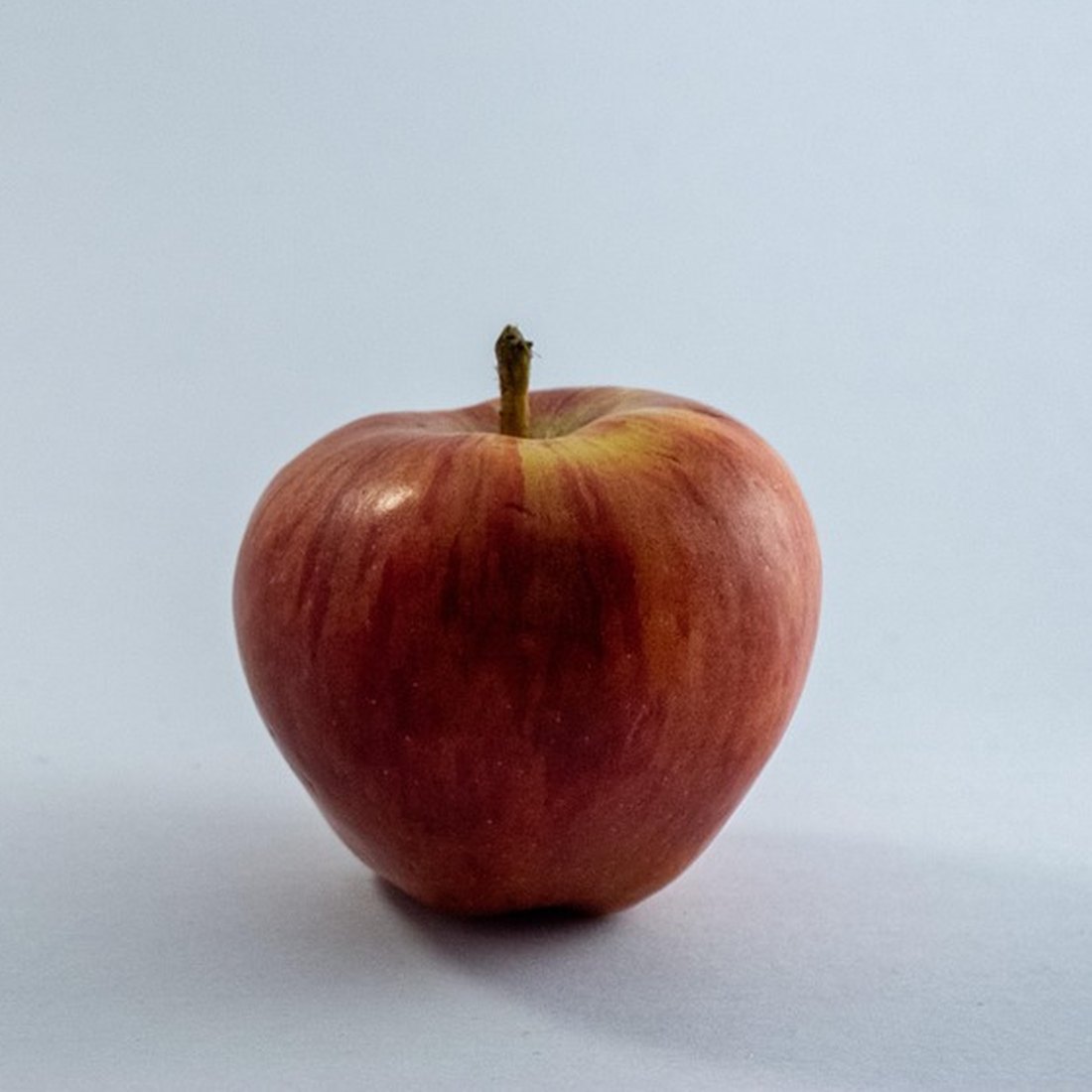
ApplePhotograph of a single red apple on a white surface.
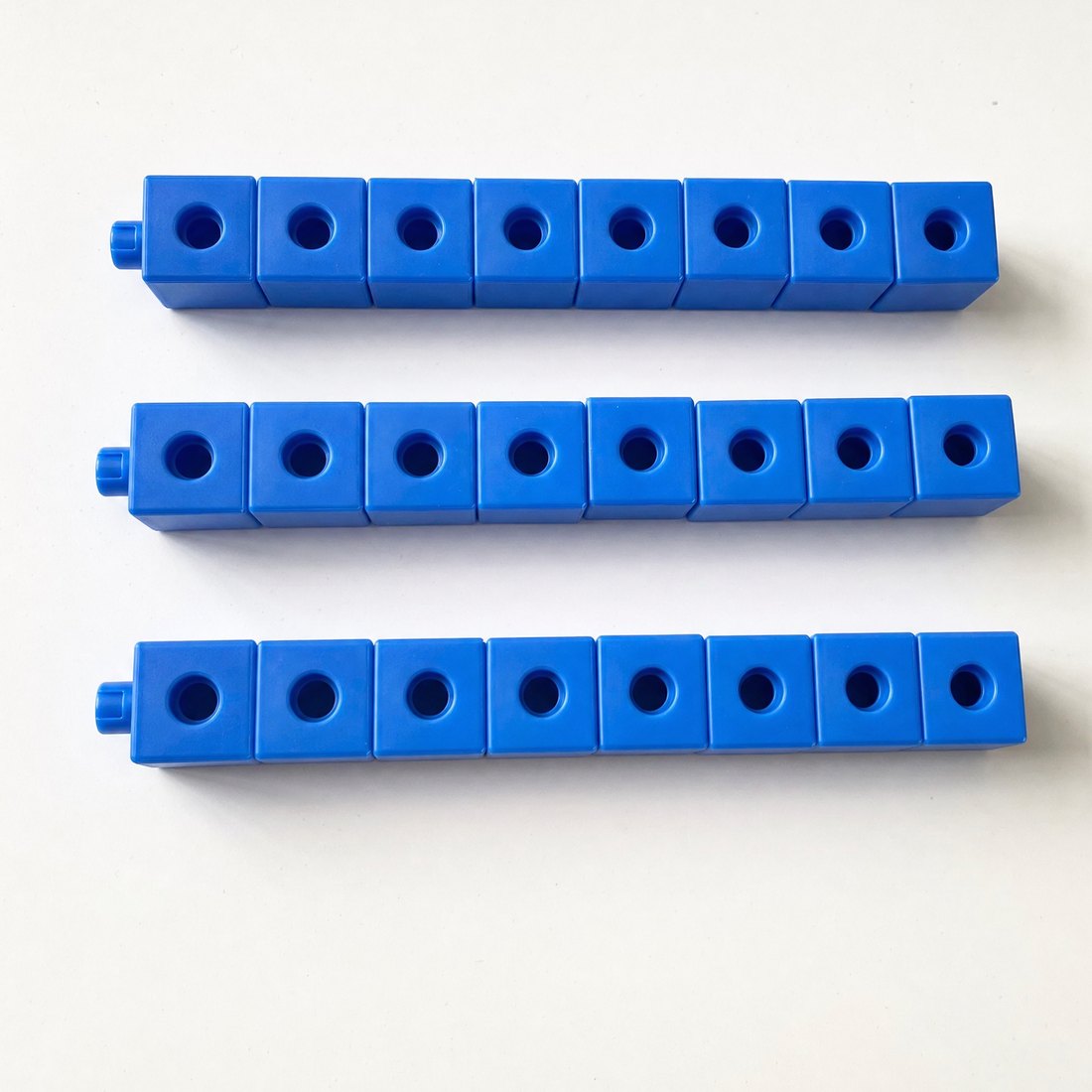
24 ÷ 8Photograph of 24 blue connecting cubes snapped into three rows of eight, lying on a white desk.
What the student gets
  • flavor
  • smell
  • texture
  • weight
  • size
  • groups you can hold
RepresentationalA picture of it
Apple
24 ÷ 8
What the student gets
  • color
  • shape
  • how many groups
  • no weight
  • no size
AbstractA symbol for it
Apple
apple
24 ÷ 8
24 ÷ 8 = 3
What the student gets
  • a name
  • a rule to run
  • meaning only if the first two are already there
Each stage drops information. The photo carries everything about the apple. The drawing keeps color and shape. The word keeps only a name. Division follows the same slope: cubes you can snap into groups, a drawing of the groups, then an expression that means nothing until the first two are in place.

Math works the same way. Without physical objects, it is hard for a student to grasp that division is the act of splitting a total into equal groups. A drawing is the next step, and it takes a bigger leap to connect a drawing to the real thing. The equation 24 ÷ 8 = 3 is pure symbol. On its own it is a pattern to execute. A student who reaches it with the cubes and the drawing behind them knows what the 3 is. Three boxes of apples.

It is also why so many adults remember the quadratic formula and not what it is for. They learned the symbol without the picture. The formula finds where a parabola crosses zero, the same arc a ball traces when you throw it across a field. Without that picture, the math is a syntax rule you follow, and a rule with no purpose is easy to forget and hard to use.

Decades of research back the sequence

CRA grows out of Jerome Bruner’s work in the 1960s. He described three modes in which people represent what they know: enactive (doing), iconic (images), and symbolic (language and notation). Math educators turned that into a teaching sequence. Special educators studied it most closely, because students who struggle in math are the ones the symbols fail first.

The evidence is consistent. A 2016 review found that CRA bridges conceptual and procedural knowledge for students with mathematics disabilities. A 2018 synthesis applied evidence-based practice standards and concluded that CRA qualifies as an evidence-based practice for teaching basic operations to students with learning disabilities. A 2025 meta-analysis of thirty single-case studies reported a large, statistically significant overall effect. And the What Works Clearinghouse guide on assisting students who struggle with mathematics makes a well-chosen set of concrete and semi-concrete representations one of its six recommendations, all rated strong evidence.

Two cautions from the same research. First, the stages are not a ladder you climb once. Students move back to objects when the symbols stop making sense, and strong lessons let them. Second, the point is the connection between stages, not the objects themselves. A drawing only helps when the student can say what each part of it stands for.

If you want to read further

  • Bruner, J. S. (1966). Toward a Theory of Instruction. Harvard University Press. The enactive, iconic, and symbolic modes that CRA is built on.
  • Agrawal, J., & Morin, L. L. (2016). Evidence-based practices: Applications of the concrete representational abstract framework across math concepts for students with mathematics disabilities. Learning Disabilities Research & Practice, 31(1). ERIC record
  • Bouck, E. C., Satsangi, R., & Park, J. (2018). The concrete–representational–abstract approach for students with learning disabilities: An evidence-based practice synthesis. Remedial and Special Education, 39(4), 211–228. Journal page
  • Ebner, S., MacDonald, M. K., Grekov, P., & Aspiranti, K. B. (2025). A meta-analytic review of the concrete-representational-abstract math approach. Learning Disabilities Research & Practice, 40(1), 31–42. Journal page
  • What Works Clearinghouse (2021). Assisting Students Struggling with Mathematics: Intervention in the Elementary Grades. Recommendation 3: use a well-chosen set of concrete and semi-concrete representations. Practice guide

Where you see it in a Kiddom Math lesson

Open Grade 3, Unit 4. Section A is called What Is Division? and runs five lessons. Across those five, students meet division with objects, then with drawings, then with expressions. The order is the model. Choose a stage to see the lesson where it happens.

  1. Course3rd Grade
  2. Unit 4Relating Multiplication to Division
  3. Section AWhat Is Division?
  4. Lessons1 · 3 · 5

Lesson 1: How Many Groups? · Activity 1: How Many Apples?

Concrete: students put 24 cubes into groups of 8

The taskA farmer puts 24 apples in boxes. She puts 8 apples in each box. How many boxes are there?
“Solve these problems and show your thinking using objects, a drawing, or a diagram.”

In the lesson.The Required Materials list connecting cubes or counters, and the launch tells you to put them in students’ hands. The teacher notes anticipate three kinds of thinking: cubes put into groups of 8, a drawing of 24 apples circled in groups of 8, and rows of 8 dots. Students choose. Then partners make a poster and the class does a gallery walk to compare what they see.

Why it matters.This is the first time these students meet division. The lesson never says the word until the synthesis, after they have already made the groups with their hands. Division arrives as something they did, not something they were told.

Two lessons later.Ten students stand at the front of the room and put themselves into groups of 2, then into 2 groups. The class watches the difference between “how many groups?” and “how many in each group?” play out with real people before anyone draws it.
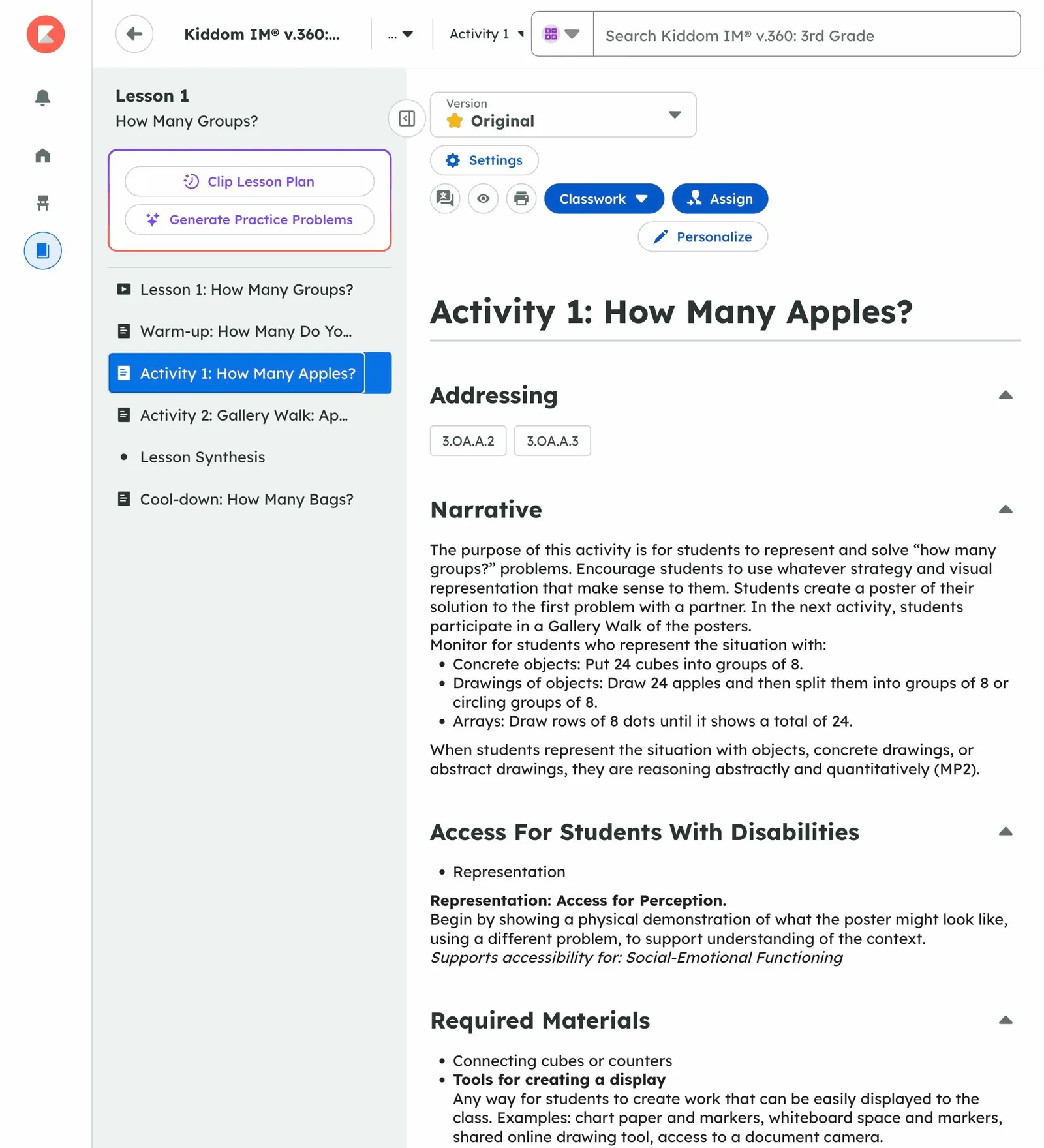
The Kiddom Math activity page for Activity 1: How Many Apples? The Narrative tells the teacher to monitor for students who use concrete objects (put 24 cubes into groups of 8), drawings of objects, or arrays. Required Materials lists connecting cubes or counters and tools for creating a display.
Activity 1 in Kiddom. The narrative names all three stages in one breath, objects, drawings, and arrays, and the materials list puts cubes on the table.

Lesson 3: Division Situation Drawings · Activity 2: Elena’s Colored Pencils

Representational: the drawing carries the meaning

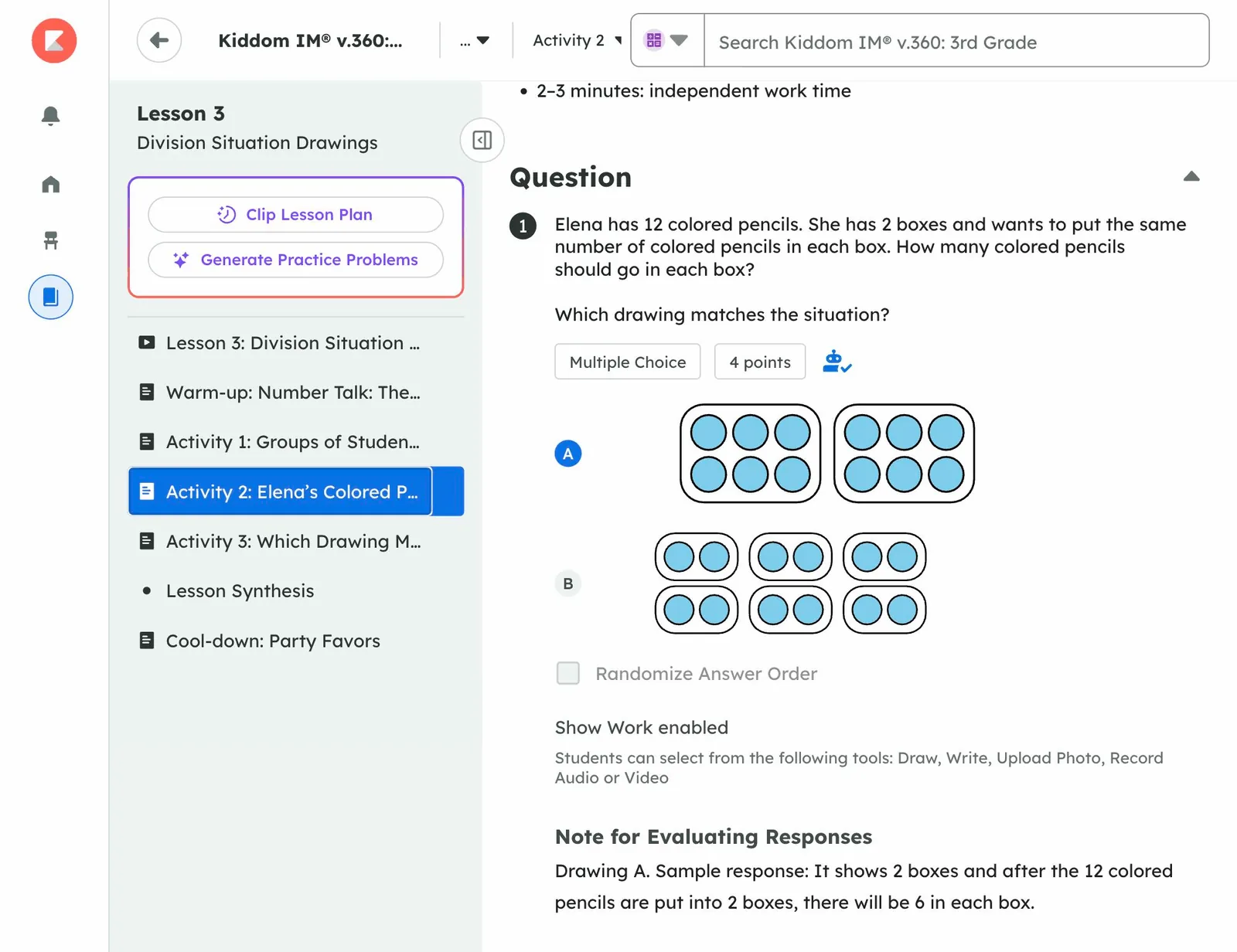
The taskElena has 12 colored pencils. She has 2 boxes and wants to put the same number of colored pencils in each box. How many colored pencils should go in each box? Which drawing matches the situation?
A
B

In the lesson.No cubes now. Students read a situation and pick the drawing that fits. Drawing A shows 2 boxes of 6. Drawing B shows 6 boxes of 2. The whole discussion is about why only one of them matches, and students refine their explanation with three different partners before the class hears it.

The leap.Later in the same lesson, students discover that one drawing can match two different stories. A drawing shows the end result, not how the groups were made. That is exactly the kind of thinking a symbol will demand of them next, because 12 ÷ 2 can also mean either story.

The check.The cool-down hands students 48 markers, 8 in each goodie bag, and two drawings. If a student picks the drawing with 8 bags instead of 8 markers in each bag, the lesson’s Responding to Student Thinking note tells you to open the next day with that exact discussion.

The Kiddom Math page for Activity 2: Elena's Colored Pencils. A multiple-choice question shows the situation and two drawings: A, two boxes of six dots, and B, six boxes of two dots. Below it, the Note for Evaluating Responses reads: Drawing A. Sample response: It shows 2 boxes and after the 12 colored pencils are put into 2 boxes, there will be 6 in each box.
Activity 2 in Kiddom. The two drawings are the whole task, and the evaluation note tells you what a correct explanation sounds like.

Lesson 5: Write Division Expressions · Activity 1: Card Sort: All About Insects

Abstract: the expression stands on its own

The taskA scientist counts 12 wings on dragonflies. Each dragonfly has 4 wings. How many dragonflies are there? Write a division expression to represent the situation.
12 ÷ 4

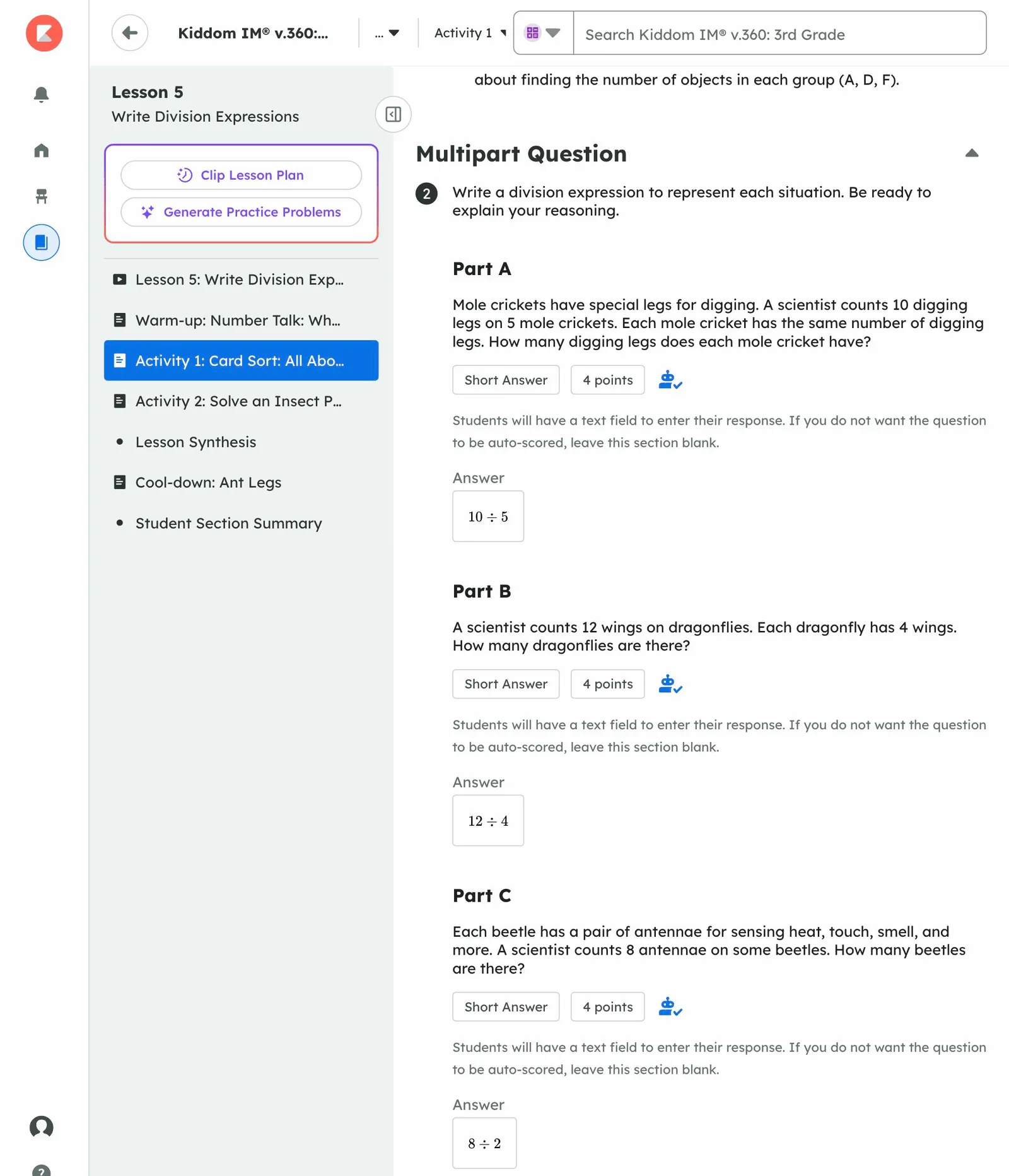
In the lesson.Students sort six insect situations into “how many groups?” and “how many in each group?” and write an expression for each: 10 ÷ 5, 12 ÷ 4, 8 ÷ 2. The synthesis asks what each number represents and where the groups are in the expression. The symbol has to answer for itself.

Why it lands.By now every student in the room has snapped cubes into groups and matched stories to drawings. When they write 12 ÷ 4, the 12 is the wings they would have counted and the 4 is one dragonfly’s share. The notation is the last layer on top of two they already own.

The check.The cool-down, Ant Legs, gives them 24 legs on 4 ants and asks for the expression and the answer. 24 ÷ 4, 6 legs. The expected work in the teacher notes still says students may draw 4 groups of 6. The drawing is allowed to stay.

The Kiddom Math page for the Card Sort activity in Lesson 5. A multipart question asks students to write a division expression for each situation. Part A, about digging legs on mole crickets, shows the answer 10 divided by 5. Part B, about dragonfly wings, shows 12 divided by 4. Part C, about beetle antennae, shows 8 divided by 2.
Lesson 5 in Kiddom. Each part is a story and a short-answer box, and the answer key is an expression. Nothing to hold, nothing to draw, unless a student wants to.

It is a loop, not a ladder

The order matters, but so does the freedom to go back. In Kiddom Math the cubes never leave the room. The Lesson 1 notes tell you to watch for students using objects, drawings, or arrays, and to let them pick. The Lesson 5 cool-down still expects some students to draw four groups of six before they write the expression. Going back to a picture is not a step down. It is the student checking that the symbol still means something.

Because the whole program lives in one place, you can see which stage a lesson is in before you teach it. The materials list, the task, the drawings, and the expected answers sit on the same page as the Assign button. When a student needs the concrete stage a little longer, Personalize lets you make your own version of an activity, with a drawing question and math manipulatives for example, while the original stays as written for everyone else.

Hold it, draw it, write it

Back to the apple. The student who held 24 cubes and made three groups knows what 24 ÷ 8 = 3 is. Not because the symbol was explained well, but because the symbol arrived last, when there was already something for it to mean. That is the whole model. Kiddom Math is built so your students do all three, in that order, with room to circle back whenever the math stops feeling real.

See it in action