
Kiddom
October 20, 2026


Tier 2 math intervention is supposed to help students succeed in the math class they are sitting in. Too often it sends them somewhere else. A student who misses a ratio problem in sixth grade gets thirty minutes of fourth-grade fraction practice, then walks back into a class that has moved on to the next lesson.
There is another way to spend that time. Keep Tier 2 tied to the unit students are learning now. Address a missing skill right before the lesson that needs it. Use the end of each lesson to decide who needs more. Spend small-group time on the exact idea students are stuck on today, so tomorrow's lesson is open to them.
This post shows what that looks like in one real Grade 6 ratios unit, step by step. It also shows where the curriculum and Atlas by Kiddom help, and where your MTSS team still makes the call.
Most Tier 2 plans start with a screener. The screener reports a skill level, and the level is often a grade or two back. So the intervention block starts there, and students work their way up through the skills they missed.
The logic is sound. The math is not always. Two problems show up in classrooms. First, a student can spend weeks on earlier skills and still meet the grade-level lesson cold, because nobody connected the two. Second, the intervention block often uses a different program, with different representations and different language, so students have two math classes that don't talk to each other.
The cost adds up. A TNTP study of five school systems found students spent more than 500 hours a school year on assignments that weren't appropriate for their grade. Students who started the year behind closed gaps faster in classrooms that gave them more grade-level work, not less.
Districts often call the alternative learning acceleration: keep students in grade-level work and give them the earlier skill just in time, inside that work. In a 2021 TNTP analysis of grade 3 to 5 classrooms, classes taught this way completed 27% more grade-level lessons than classes that were remediated. Instead of fixing every gap first, you fix the gap that stands between a student and tomorrow's lesson.
Two ways to spend the same 30 minutes of Tier 2 time
The most cited guidance on math intervention comes from the What Works Clearinghouse, the U.S. Department of Education's review of what the evidence supports. Its 2021 practice guide for grades K to 6 describes intervention as a chance for students to build understanding of "the most critical grade-level topics," and asks that it complement grade-level instruction.
All six of its recommendations rest on strong evidence: systematic instruction, clear mathematical language, a well-chosen set of concrete and visual representations, the number line, deliberate work on word problems, and timed activities to build fluency. The earlier 2009 guide, which also covers middle school, adds that intervention in grades 4 to 8 should focus on rational numbers, and it names ratios.
That 2009 guide makes one more point worth taking seriously. Its panel judged that building foundational skills matters more than lining intervention up with the core curriculum, while asking for links to grade-level material whenever possible. Grade-level Tier 2 doesn't argue with that. It asks which foundation to build first, and answers: the one the next lesson depends on.
Notice what none of these practices require: a separate program. Systematic instruction, number lines and double number lines, and word problems built on common structures are what a strong grade-level lesson already uses. The question is whether your Tier 2 time uses them on the math students need this week.
Kiddom Math is built on Kiddom IM® v.360, and its units already carry three checkpoints that make grade-level Tier 2 practical. One comes before the unit. One comes at the end of every lesson. One comes at the start of the next class. The rest of this post walks through each, using Grade 6 Unit 2, "Introducing Ratios".
Where the decisions happen in Grade 6 Unit 2
Six items on the prior skills this unit leans on. Each one names the lesson where the skill is first needed.
A five-minute check on the day's goal, with guidance on whether a miss needs action now or will be revisited.
Small groups built on the misconception behind each answer, plus an extension for students who are ready.
Units in Kiddom Math open with a short pre-unit check called Check Your Readiness. It doesn't try to place a student on a grade-level scale. It asks about the handful of earlier skills this unit will actually use.
For the ratios unit, that means equivalent fractions, multiplying and dividing to answer "B is A times what number?", reading a number line, scaling a recipe and comparing speeds. The unit narrative explains why: ratios build on converting measurements in grade 3, multiplicative comparison in grade 4 and multiplication as scaling in grade 5.
The useful part is what each item says to do next. Every item names the lesson where its skill first matters, and gives a plan if most students struggle. For the equivalent fractions item, the guidance reads: "If most students struggle with this item, plan to use this item for some error analysis before beginning Lesson 5."
Illustrative Mathematics' teacher guidance puts the principle plainly: address below-grade skills while continuing the on-grade work of the unit. That is grade-level intervention in one sentence. The support is scheduled for the day before the lesson that needs it. It is short, it uses the item students just worked on, and it connects straight to the grade-level work.
One readiness item, and where each skill is needed
Here are three fractions. Two of them are equivalent. Which two?
If most students struggle: use this item for error analysis before beginning Lesson 5, "Defining Equivalent Ratios".
| Readiness item | Needed in |
|---|---|
| Multiplying and dividing: "28 is 7 times what number?" | Lesson 3 |
| Scaling a brownie recipe to 3 batches | Lesson 3 |
| Equivalent fractions | Lesson 5 |
| Labeling a number line, fractions on a number line | Lesson 7 |
| Which travels faster, a car or a train | Lesson 9 |
A readiness check happens once. The cool-down happens every day. It is a short task at the end of each lesson that checks the day's goal, the same idea many teachers call an exit ticket.
In this curriculum, each cool-down also comes with guidance on how to respond. The guidance falls into three categories, and they matter for Tier 2 because they tell you when not to intervene as much as when to.
The three kinds of cool-down guidance, and how often each appears in Grade 6 Unit 2
Students will see this content again. No need to change the plan for the class.
Build small adjustments into upcoming lessons, such as revisiting a common error in a launch.
Students may need more time here before new lessons. Add optional activities or revisit earlier content.
Take Lesson 11, "Representing Ratios with Tables". Its cool-down gives students a cookie recipe table (5 cups of flour to 2 teaspoons of vanilla) and asks them to complete a row for a new batch size. The curriculum warns about a specific error: some students add the same amount to both columns instead of scaling them. The response category for this cool-down is More Chances, because ratio tables come back in the very next lesson.
So the honest answer for most of the class is: keep going. But the students who added instead of scaled still need something before Lesson 12 asks them to navigate a table "like a pro". That is a Tier 2 moment, and it is a small, specific one.
Here is where most teachers run out of time. Sorting 28 cool-downs by the reason each student missed, then writing a different ten-minute activity for each reason, is a full evening of work.
Atlas by Kiddom does that sorting. Atlas reads each cool-down within minutes of submission and groups students by the misconception behind their answer, not by their score. For each group, it creates an activity for the start of the next class, with a facilitation note and guiding questions for the teacher. When one misconception runs through most of the class, Atlas can build a whole class activity instead.
For Lesson 11, that looks like two intervention groups: students who added instead of scaling, and students who scaled one quantity but not the other. A third group of students who showed no misconception gets an extension. The teacher can move any student, change the approach or edit the activities before assigning them.
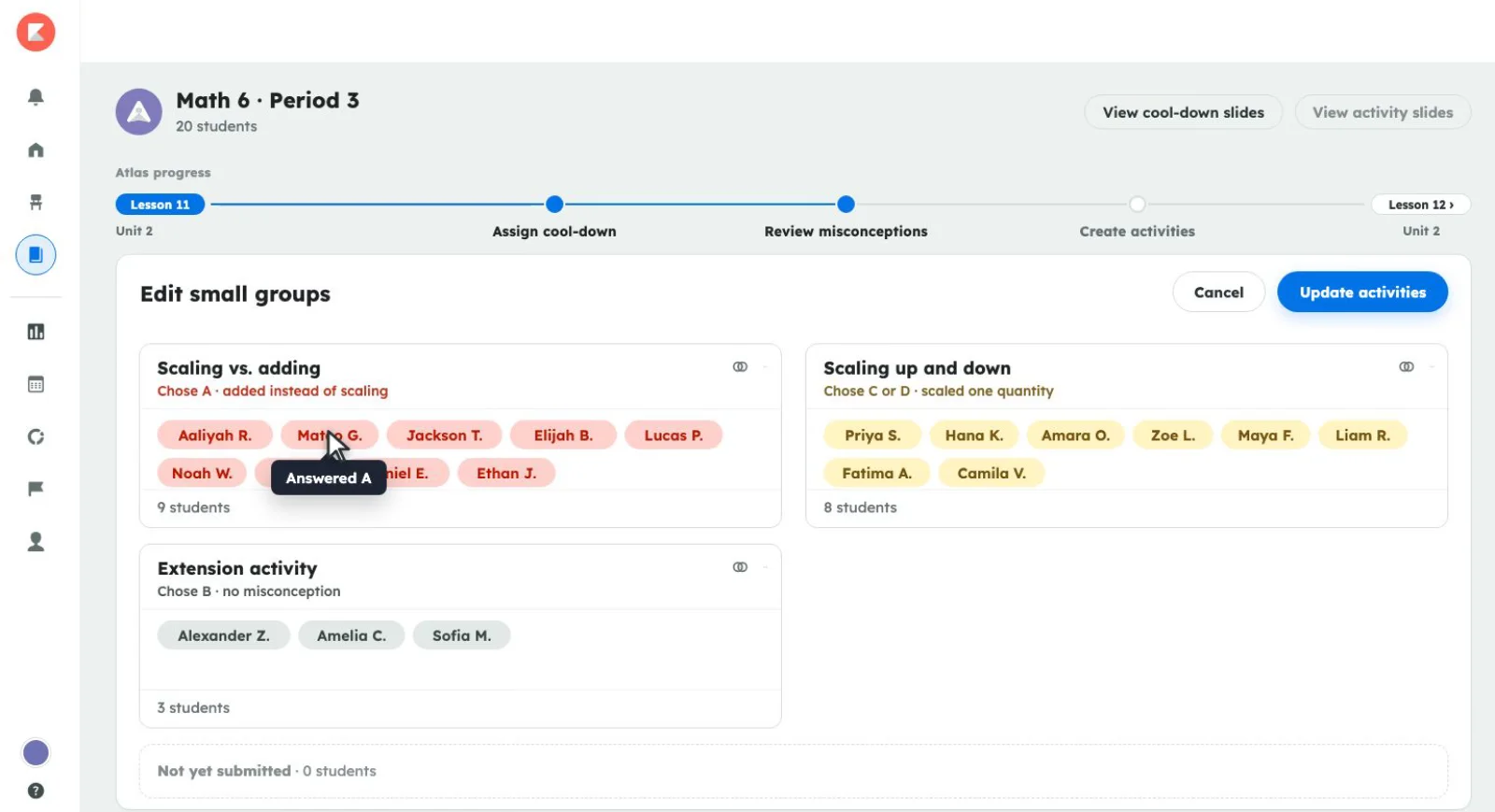
Those activities become the next lesson's Do Now. That placement is the point. The small-group time happens in the opening minutes of Lesson 12, on the exact idea Lesson 12 builds on, and then every student moves into the same grade-level lesson together. No one leaves the unit to get help with it.
Grade-level Tier 2 has a mirror image. Students who already have the idea need something too, and the usual answer is to move them to the next topic. That creates the same split in the other direction.
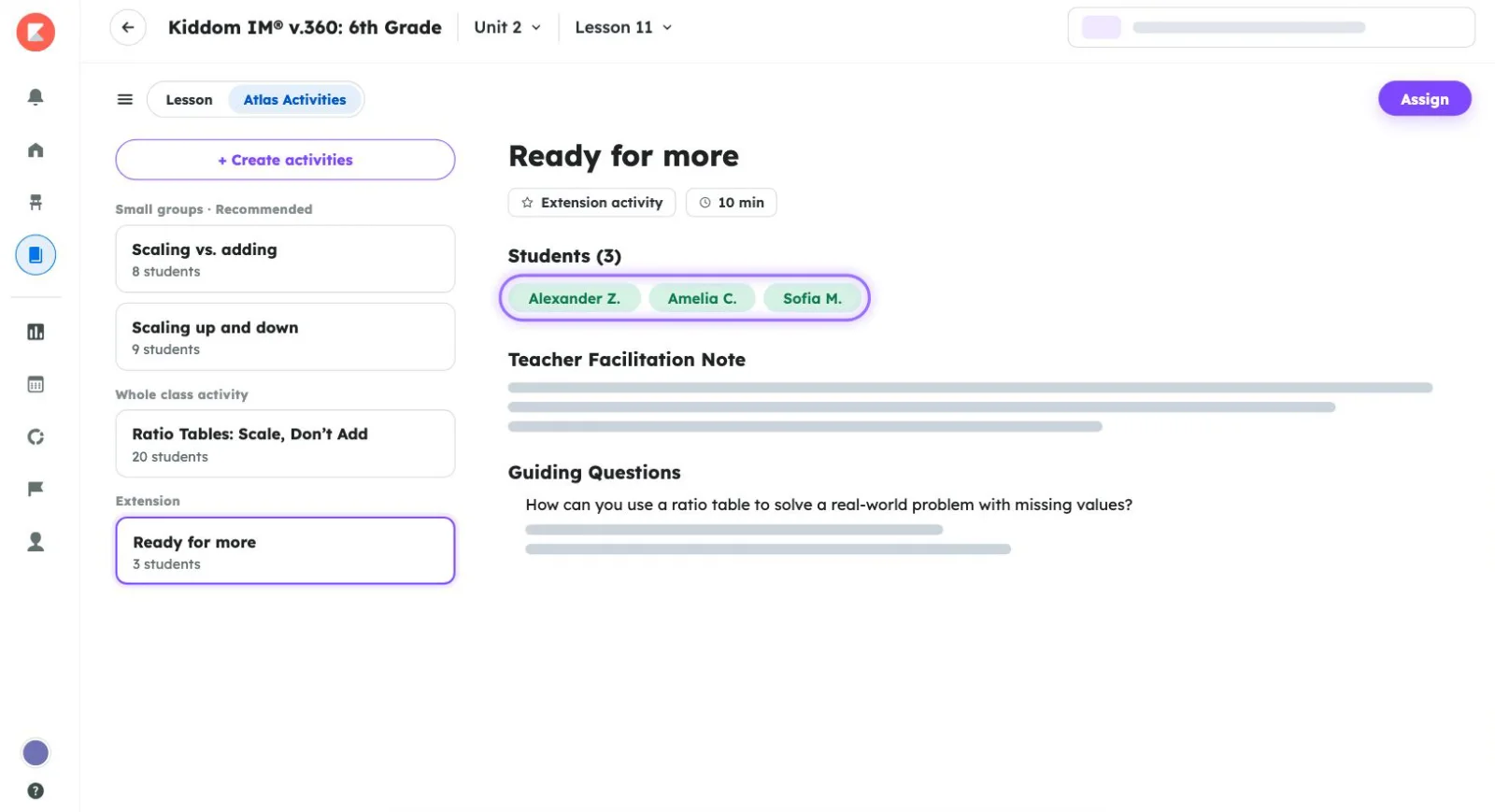
Atlas extensions don't move students on to the next concept, and they aren't a gifted program. They reinforce the lesson students just learned at a higher level of rigor. In gifted-education terms, this is enrichment, not acceleration. In Lesson 11, the "Ready for more" group stays with ratio tables and the same standard, 6.RP.A.3a, but works with harder numbers, such as non-integer scale factors, and writes ratio table problems of its own.
The whole class ends up in the same place: the next grade-level lesson. Some students got there with a targeted reteach. Some got there by stretching further on the same idea. Nobody skipped ahead or fell behind the unit.
In most MTSS models, Tier 1 is core instruction for every student and Tier 3 is intensive, individualized intervention. The Center on MTSS at the American Institutes for Research describes Tier 2 as small-group, standardized support for about 15 to 20% of students, provided in addition to Tier 1 and aligned to it. The 2009 WWC guide puts typical Tier 2 sessions at 20 to 40 minutes, four to five times a week.
The approach in this post strengthens Tier 1 and gives Tier 2 time a grade-level target. It doesn't replace the rest of your MTSS system, and it is worth being clear about where it stops.
Tier 2 math intervention is targeted small-group support for students who need more than core instruction, given in addition to Tier 1 rather than instead of it. Sessions often run 20 to 40 minutes, several times a week. The strongest Tier 2 time builds the specific skills students need for the grade-level math they are learning now.
Tier 1 is core instruction for every student. Tier 2 adds targeted small-group support for some students, often about 15 to 20% of a school. Tier 3 is intensive, individualized intervention for students who need more than Tier 2, usually delivered by a specialist.
Aligned intervention works on the same math, with the same representations and language, that students meet in their core lessons. Instead of running a separate program, it fills the earlier skill the next grade-level lesson depends on. In Kiddom Math, each unit's Check Your Readiness names the lesson where each prerequisite is first needed, so support can land right before that lesson.
Group students by the reason behind their answer, not by score, because two students with the same score can be stuck on different ideas. A daily cool-down or exit ticket is enough to form groups for the start of the next class. In Kiddom Math, Atlas by Kiddom reads each cool-down within minutes of submission and groups students by misconception, and the teacher reviews and edits the groups.
A strong session has one clear goal, explicit modeling, guided practice with feedback and a quick check at the end. The What Works Clearinghouse recommends systematic instruction, clear math language, visual representations such as number lines, and deliberate work on word problems. When the session targets the misconception from the last lesson, students can use what they practiced in the very next one.
Teach the earlier skill just in time, inside grade-level work, instead of reteaching whole earlier units first. Check which prerequisites a unit needs, address each one right before the lesson that uses it, and keep students in the grade-level lesson. Illustrative Mathematics' teacher guidance makes the same point: address below-grade skills while continuing the on-grade work.
Look for supports that connect to the core curriculum students already use, with the same representations, the same language and a clear link to grade-level lessons. Check the evidence behind the practices against sources such as the What Works Clearinghouse practice guides. Make sure teachers can see why students are struggling, not just a score, and that students who are ready can go deeper on the same standard.
Research and practice
More from Kiddom
The strongest Tier 2 time looks a lot like good core instruction, delivered to fewer students at the right moment. Check the skills a unit needs right before the lesson that needs them. Let the cool-down tell you who needs more. Then spend small-group time on today's idea, so tomorrow's lesson belongs to every student.