
Kiddom
August 12, 2026


Ms. Delgado teaches four sections of 6th grade math. That’s 112 students.
After the final bell, she has about 20 minutes before after-school tutorials begin. In that time, she needs to look at the day’s Cool-Downs, see who needs help, understand what went wrong, and decide what to do tomorrow.
A score can tell her that a student missed a question. It cannot always tell her why.
That distinction matters. Different mistakes need different teaching. And when a teacher has a stack of 112 responses, figuring that out for every student is hard to do before the next lesson begins.
Consider a lesson on ratios.
Students are looking at a cookie recipe. The table shows 5 cups of flour for every 2 teaspoons of vanilla. Then it asks students to complete a new row.
Priya writes 6 cups of flour and 3 teaspoons of vanilla.
Her answer is wrong, but it is not random. Priya sees that 5 is 3 more than 2. So she keeps that same difference in the next row: 6 is 3 more than 3.
Her rule makes sense to her. The problem is that a recipe does not work by keeping the difference between the numbers the same. It works by keeping their relationship the same. If the flour doubles, the vanilla has to double too.
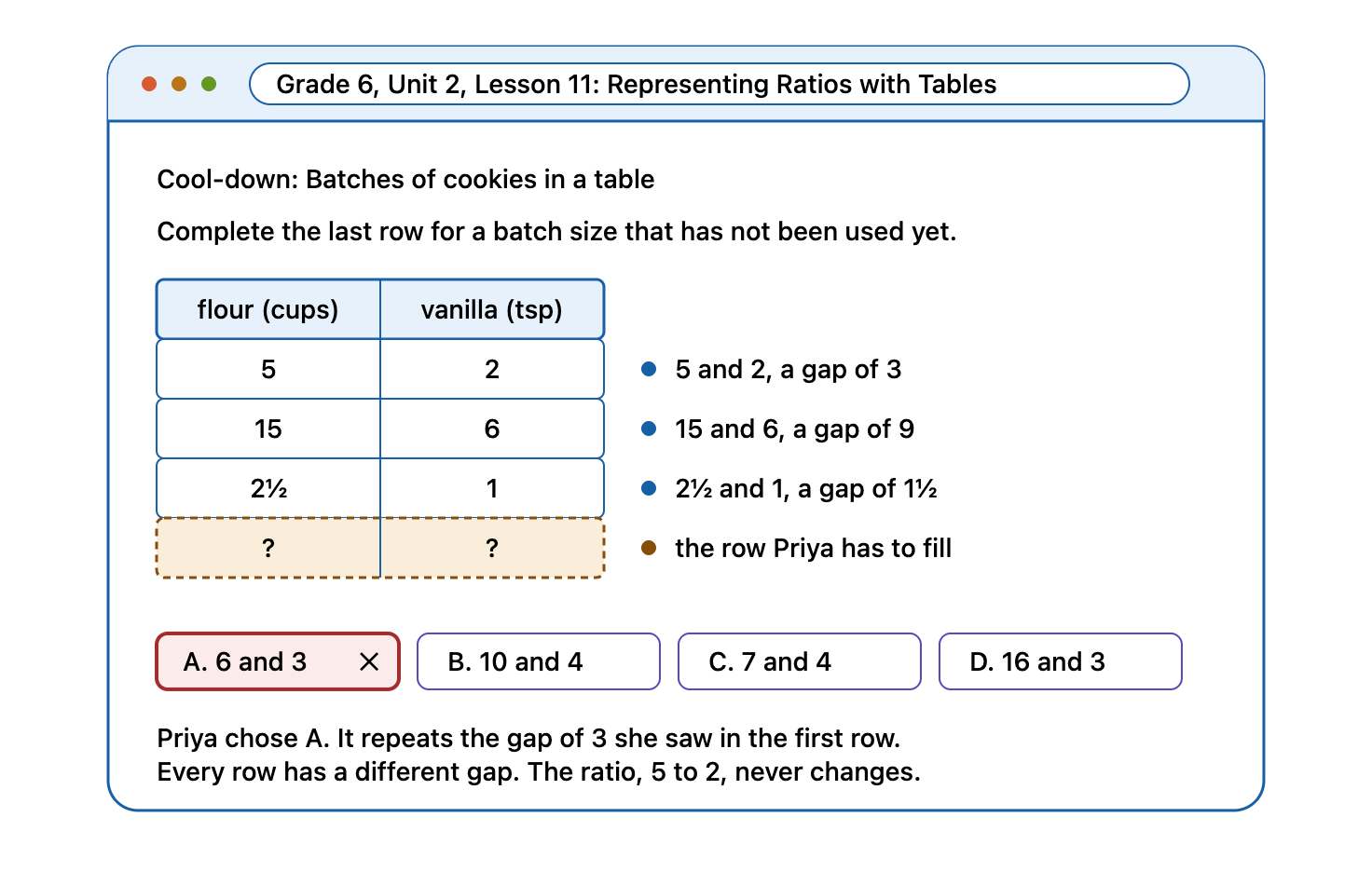
That is the piece a teacher needs to see. Priya does not need a generic lesson on multiplication. She needs help understanding that ratios scale.
Without that context, her response could look like a small calculation error. With it, Ms. Delgado knows what conversation Priya needs.
Atlas is built into the curriculum teachers already use. It reads every Cool-Down, identifies the misconception in a student’s response, groups students who need similar support, and prepares differentiated activities for the next day.
For Priya, Atlas identifies that she is tracking the difference between the two numbers when she needs to track the ratio. The response is tied to the grade-level standard, 6.RP.A.3a, and points to a practical next step: give her a scaling problem where her approach stops working.
Atlas also shows Ms. Delgado which students need the same help.
In this class, six students are using the same difference-based strategy as Priya. Four more can scale quantities up, but get stuck when they need to scale down by a fraction. They are working on the same lesson, but they do not need the same intervention.
That is difficult to see from a score alone.
Without Atlas, teachers often have to improvise. They may group students by who got an answer wrong, then search for a remediation packet or pull a skill from an earlier grade because it is quick and available. The work may fill a gap, but it can be disconnected from the lesson students are in now.
Atlas takes a different approach. It uses what students showed in that day’s Cool-Down to surface support from the curriculum itself. Priya is not sent back to generic multiplication review. She gets a short activity that addresses her ratio misconception and keeps her connected to the next grade-level lesson.
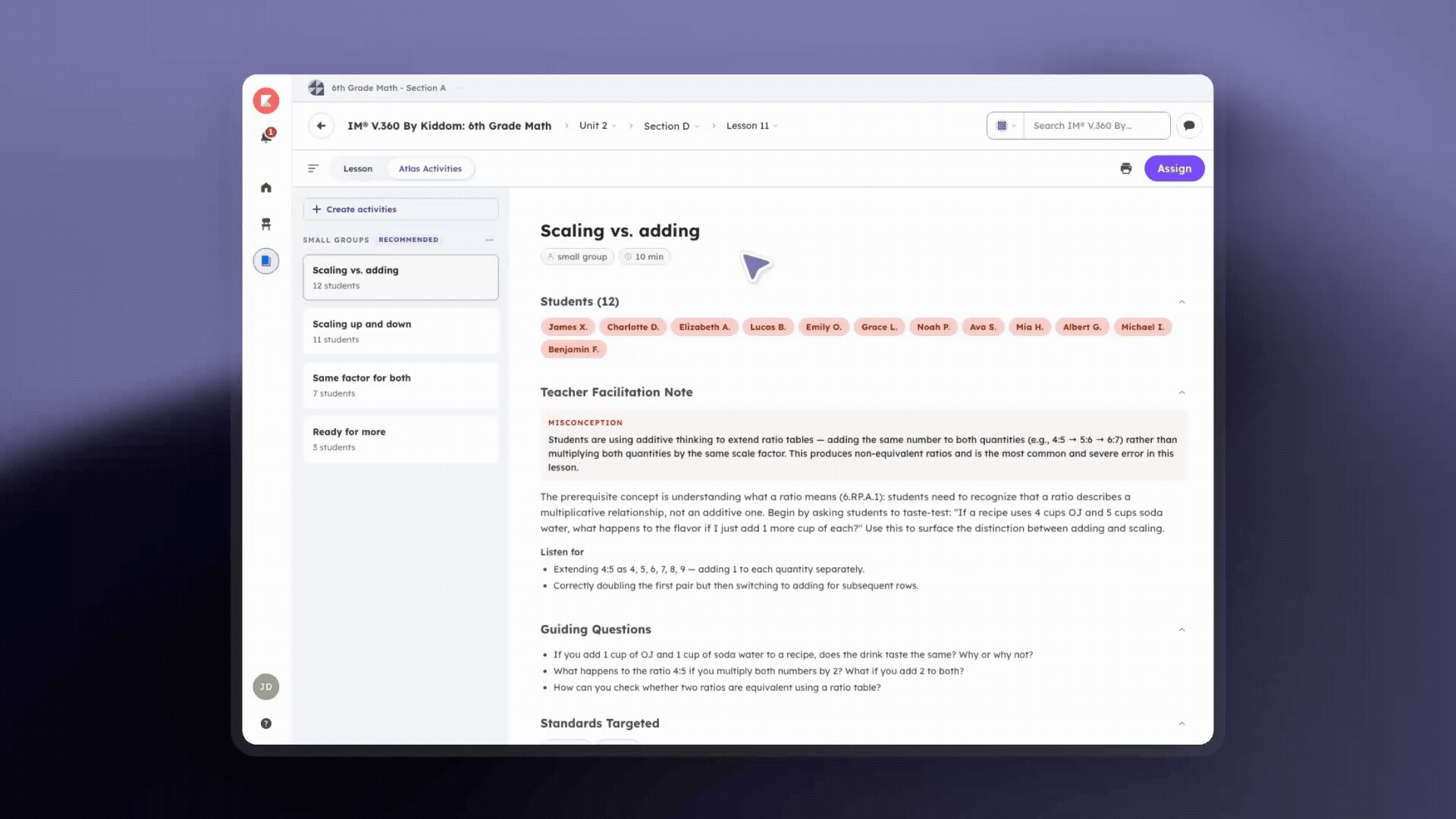
For Priya’s group, the intervention before Lesson 12 returns to a recipe from the prior day: 4 liters of orange juice for every 5 liters of soda water. Students need to scale the recipe to 36 liters of orange juice.
Priya’s difference-based approach would produce 36 liters of juice and 37 liters of soda water. The numbers are one apart, but the recipe is clearly off. If the orange juice has been multiplied by nine, the soda water needs to be multiplied by nine as well. The correct amount is 45 liters.
The example gives Priya something useful: a way to see why her rule breaks down.
The six students with the same misconception receive that intervention. The four students who need practice scaling up and down receive a different mini-activity. Other students practice applying the same scale factor. The rest of the class begin Lesson 12, Navigating a Table of Equivalent Ratios.
Everyone is still working in the same unit. No one is sent backward to unrelated review work.
Every IM v.360 lesson already ends with a Cool-Down. Teachers collect them every day, but close analysis can wait until a unit test exposes a problem. By then, a misconception that could have been addressed in a warm-up may require several days of reteaching.
Atlas helps teachers use those responses the next morning.
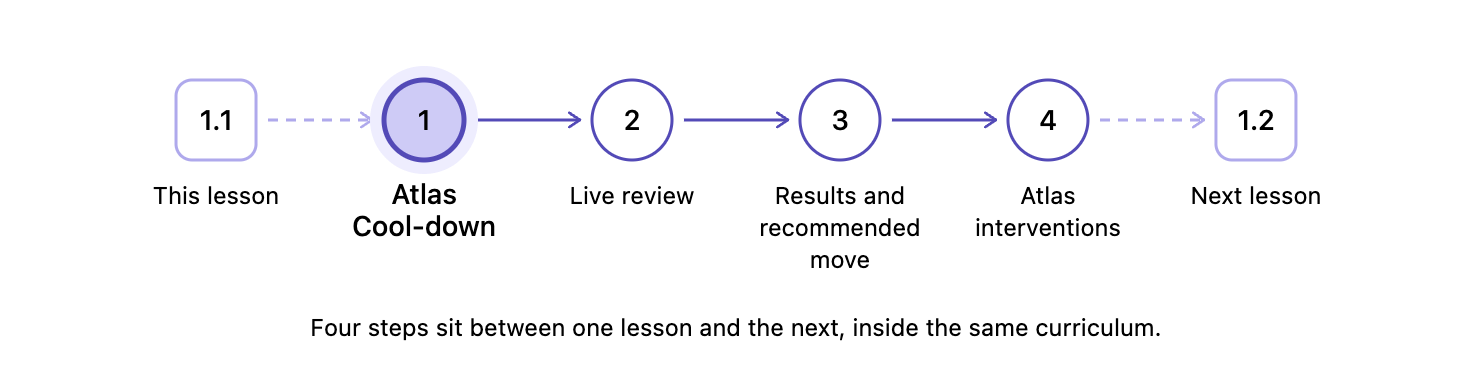
At the end of one lesson, students complete a Cool-Down. Atlas surfaces patterns in their reasoning and prepares activities for the next day. The teacher decides how to use them.
Ms. Delgado still makes the instructional calls. She can see Priya’s group of six and choose to sit with them while the rest of the class works.
The conversation may only take four minutes. But it is the right four minutes.
She has time for it because she is not spending the same time sorting through 112 Cool-Downs at her desk.
Learn more about Atlas: kiddom.com/atlas.