What to do with exit ticket data tomorrow: a 3-group plan for small-group instruction

What to do with exit ticket data: sort students into three groups by the reason they missed, then use the first ten minutes of the next class to close the gap.
Purple Kiddom tile pattern
Kiddom logo
Kiddom
October 12, 2026

The exit ticket is the easy part

Exit ticket data is only worth collecting if it changes what happens in the next class. Picture 2:50 on a Tuesday. Twenty exit tickets sit on the corner of your desk, and Wednesday’s lesson is already planned. You can flip through the stack in four minutes. Some students got it and some did not. Then Wednesday starts with the warm-up you planned last week, and the stack goes into a folder.

That is the real problem. Writing an exit ticket is easy. Reading one is quick. The hard part is turning twenty answers into a different first ten minutes, before the next class, without writing three new lessons that night.

The short answer Sort the tickets by the reason students missed, not by their score. Most stacks fall into three groups: students who share one misconception, students who are almost there, and students ready for more. Spend the first ten minutes of the next class giving each group one targeted task, then let the next exit ticket tell you whether it worked.

This post walks through that plan with a real sixth-grade lesson. In Kiddom Math, the exit ticket is called a cool-down: a five-minute task at the end of every lesson, written by the curriculum authors to check the lesson’s main idea. Everything here works with any exit ticket. The cool-down makes the example concrete, and it comes with one piece of guidance most exit tickets don’t, which matters more than it sounds.

Sort by the reason, not the score

The usual move is to sort by score. Three piles: got it, sort of, not yet. It is fast, and it is the structure most guides recommend. The trouble is that a score tells you how many answers were right, not why the others were wrong. Two students can both score 2 out of 3 for different reasons. One added when they should have multiplied. The other multiplied, but by a different number on each side. They need different ten minutes.

Sort by the reason instead, and the same three piles become something you can teach to.

  • 1The same misconception

    Students who made the same wrong move for the same reason. One short conversation reaches all of them at once, so this group sits with you.

  • 2Almost there

    Students who have the right idea and lose it in one step. They need practice that isolates that step, not a reteach.

  • 3Ready for more

    Students who got it and can explain why. They need something harder, not more of the same.

Three is not a magic number. It is a manageable default for ten minutes with one teacher. Group 2 sometimes splits, because there is more than one way to almost get it. That is fine, as long as each group still has its own reason and its own next step. Atlas by Kiddom works the same way: it creates as many groups as the evidence calls for, not a fixed number.

Twelve exit tickets, sorted two ways

Each ticket is one student’s answer to “complete the last row” from the cool-down in the next section. The coloured edge is the reason behind the answer.

3 of 3 3 tickets

Alexander Z. 3/310 and 4 · two batches
Amelia C. 3/350 and 20 · ten batches
Sofia M. 3/37½ and 3 · one and a half batches

2 of 3 5 tickets

Jackson T. 2/37 and 4 · added 2 to each
Aaliyah R. 2/317 and 8 · each row adds 2
Priya S. 2/36 and 3 · kept the difference of 3
Hana K. 2/310 and 6 · doubled one, tripled the other
Amara O. 2/325 and 12 · times 5, times 6

1 of 3 3 tickets

Elijah B. 1/36 and 3 · plus 1 on both
Lucas P. 1/34 and 1 · minus 1 on both
Zoe L. 1/31 and ½ · scaled down unevenly

0 of 3 1 ticket

Noah W. 0/320 and 11 · added 5 to each

Added instead of scaled 6

Jackson T. 2/37 and 4 · added 2 to each
Aaliyah R. 2/317 and 8 · each row adds 2
Priya S. 2/36 and 3 · kept the difference of 3
Elijah B. 1/36 and 3 · plus 1 on both
Lucas P. 1/34 and 1 · minus 1 on both
Noah W. 0/320 and 11 · added 5 to each

Multiplied, but not evenly 3

Hana K. 2/310 and 6 · doubled one, tripled the other
Amara O. 2/325 and 12 · times 5, times 6
Zoe L. 1/31 and ½ · scaled down unevenly

Ready for more 3

Alexander Z. 3/310 and 4 · two batches
Amelia C. 3/350 and 20 · ten batches
Sofia M. 3/37½ and 3 · one and a half batches
Illustrative answers, not real student work. Sorted by score, the 2-of-3 pile mixes three students who added with two who multiplied unevenly, and the 1-of-3 pile does the same. Sorted by reason, every student in a pile needs the same next step.

One cool-down, three groups

Here is a real one. Kiddom Math Grade 6, Unit 2 Introducing Ratios, Lesson 11 Representing Ratios with Tables. Students spend the lesson building tables of equivalent ratios from recipes: orange juice and soda water, then a nihaizu sauce of vinegar and soy sauce. The cool-down, Batches of Cookies in a Table, gives them a three-row table of flour and vanilla and a blank fourth row. The last question is the one that sorts the room.

The cool-down, and three ways to finish the last row

Cool-down 11.4 · Batches of Cookies in a Table · 5 minutes
flour (cups)vanilla (teaspoons)
52
156
2½1
  1. Write a sentence that describes a ratio shown in the table.
  2. What does the second row of numbers represent?
  3. Complete the last row for a different batch size that hasn’t been used so far in the table. Explain or show your reasoning.
Jackson T.Same misconception

7 cups · 4 teaspoons

“I added 2 to each.” A pattern that looks like a rule, and a different cookie.

Hana K.Almost there

10 cups · 6 teaspoons

“Doubled the flour, tripled the vanilla.” She knows to multiply, but not by the same number.

Alexander Z.Ready for more

10 cups · 4 teaspoons

“Two batches, so double both.” Right answer, and he can say why.

The table and questions are the curriculum’s. The three answers are illustrative. All three students got question 2 right, so two of them could share a score with very different needs.

The curriculum already knows what Jackson will write. In the teacher notes for the nihaizu activity earlier in the same lesson, under Building On Student Thinking, it names the pattern:

“Students may make patterns that do not yield equivalent ratios. For example, they may think ‘7 minus 2 is 5, so for the next row, 28 minus 2 is 26.’” Kiddom Math Grade 6, Unit 2, Lesson 11, Activity 3

That is Group 1: adding or subtracting the same amount on both sides instead of multiplying. It produces numbers that feel right, which is why it survives. Hana is Group 2. She has the big idea, that equivalent ratios come from multiplying, and uses a different factor on each column. Alexander is Group 3. He thinks in batches, which is the idea the whole unit is building.

Tomorrow’s first ten minutes

The next lesson, Lesson 12 Navigating a Table of Equivalent Ratios, opens with a 10-minute warm-up. That slot is where the exit ticket pays off. For one day, the warm-up becomes a grouped Do Now. Each group gets one task aimed at the reason it missed. At minute ten, everyone moves into Lesson 12 together. The tasks below are the ones Atlas by Kiddom created for this cool-down in the Atlas demo class.

Lesson 12, with the warm-up turned into a grouped Do Now

Atlas Kiddom Math, Lesson 12 Atlas
Do Now10 minAtlas3 groups, below ↓
Taco prices15 minKiddom Math
Hourly wages15 minKiddom Math
Memory cards15 minKiddom Math
Synthesis5 minKiddom Math
Cool-down5 minAtlas

Inside the 10-minute Do Now

Group 1 · same misconception Atlas activity: Scaling vs. adding · small group · 10 min

The Teacher Facilitation Note names the error, adding the same number to both quantities, and opens with a taste test: if a recipe uses 4 cups of orange juice and 5 cups of soda water, what happens to the flavor if you add 1 more cup of each? Three practice questions follow, then one sentence from each student on why adding breaks the ratio.

Group 2 · almost there Atlas activity: Same factor for both · small group · 10 min

Students write each row as a fraction and check that every row simplifies to the same value. One practice question uses this cool-down’s own recipe: a student wrote 5:2, 10:6, 15:10, so find the error. Students who scale up but not down get a sibling activity, Scaling up and down, that starts from 12:20 and asks for 3:5.

Group 3 · ready for more Atlas activity: Ready for more · extension · 10 min

Enrichment within the same standard, not the next lesson early: how much vanilla for 12.5 cups of flour, when the scale factor is not a whole number, and whether 4:5 and 5:4 are the same drink. The note closes with an open challenge to write their own ratio table problem.

Minutes from the Lesson 12 timeline; bar lengths are approximate. Atlas owns the two ends of the lesson: the cool-down that produces the evidence and the Do Now that uses it. Everything between is the Kiddom Math lesson, grade-level work for the whole class. Each Atlas activity comes with a Teacher Facilitation Note, three practice questions, and a closing synthesis prompt. Which group sits with you is your call; most teachers start with Group 1.

Notice what the Do Now is for. It does not replace Lesson 12 or slow it down. Its only job is to get each group ready for the same grade-level work: taco prices, hourly wages, and a matching game, all built on tables of equivalent ratios. Group 1 walks into those activities having just seen why adding breaks a recipe. Group 3 walks in having been stretched instead of waiting.

Not every miss needs a reteach

Here is the part generic advice leaves out. Sometimes the right response to a miss is to keep going. Every Kiddom Math cool-down carries a note called Responding To Student Thinking, and the Course Guide sorts that guidance into three categories.

Three ways the curriculum tells you to respond

More Chances

Students will see this content again. There is no need to change the plan for the class.

Lessons 11 and 12 in this unit

Points to Emphasize

Build a small adjustment into the next few lessons, like more students sharing strategies or a changed launch.

Lesson 2, describing ratios

Press Pause

Students may need more time before new lessons. Add an optional activity or revisit earlier work.

Lesson 10, comparing rates

Paraphrased from the Assessment Guidance in the Kiddom Math Grade 6 Course Guide. Each cool-down names one category and adds lesson-specific advice.

Lesson 11 is More Chances. In the curriculum’s words: “There is no need to slow down or add additional work to the next lessons.” Lesson 12 keeps working with ratio tables, so Jackson will get more practice whether you plan it or not.

That doesn’t mean ignoring Group 1. It means the response should be the size of the problem. A ten-minute Do Now is the right size for More Chances: targeted, then back on pace. A Press Pause cool-down, like Lesson 10’s on comparing rates, might earn the optional activity the curriculum suggests. Knowing which kind of miss you are looking at keeps you from spending a day on something the next lesson was going to fix anyway.

Check that it worked

The re-check is already on the calendar. Lesson 12 ends with its own cool-down, Price of Bagels: bagels at $5 a dozen, how much for 6, how many for $50. Different context, same idea. Read Group 1’s answers first. If the students who added are now scaling, that group is done. If two of them still add, they are tomorrow’s teacher table.

Three habits keep this honest:

  • Groups last one day. Build them from one exit ticket and rebuild them from the next. A student who added on Tuesday may be ready for more by Thursday.
  • Re-check in a new context. If the follow-up uses the same numbers, you are checking memory, not understanding.
  • Act before the next class. A misconception that waits a week has five more lessons to settle in.

Where Kiddom does the sorting

Sorting twenty tickets by reason takes longer than sorting by score. You have to read every answer for the thinking behind it. That is the step Atlas takes off your desk. In Kiddom Math, Atlas by Kiddom reads each cool-down within minutes of submission, identifies what each student misunderstood, and groups students who share the same misconception. It recommends a response and explains why. You choose, and Atlas prepares the materials before the next class. The decision stays with you. The preparation doesn’t.

Lesson 11 · Atlas Cool-down

Assign it where you teach it

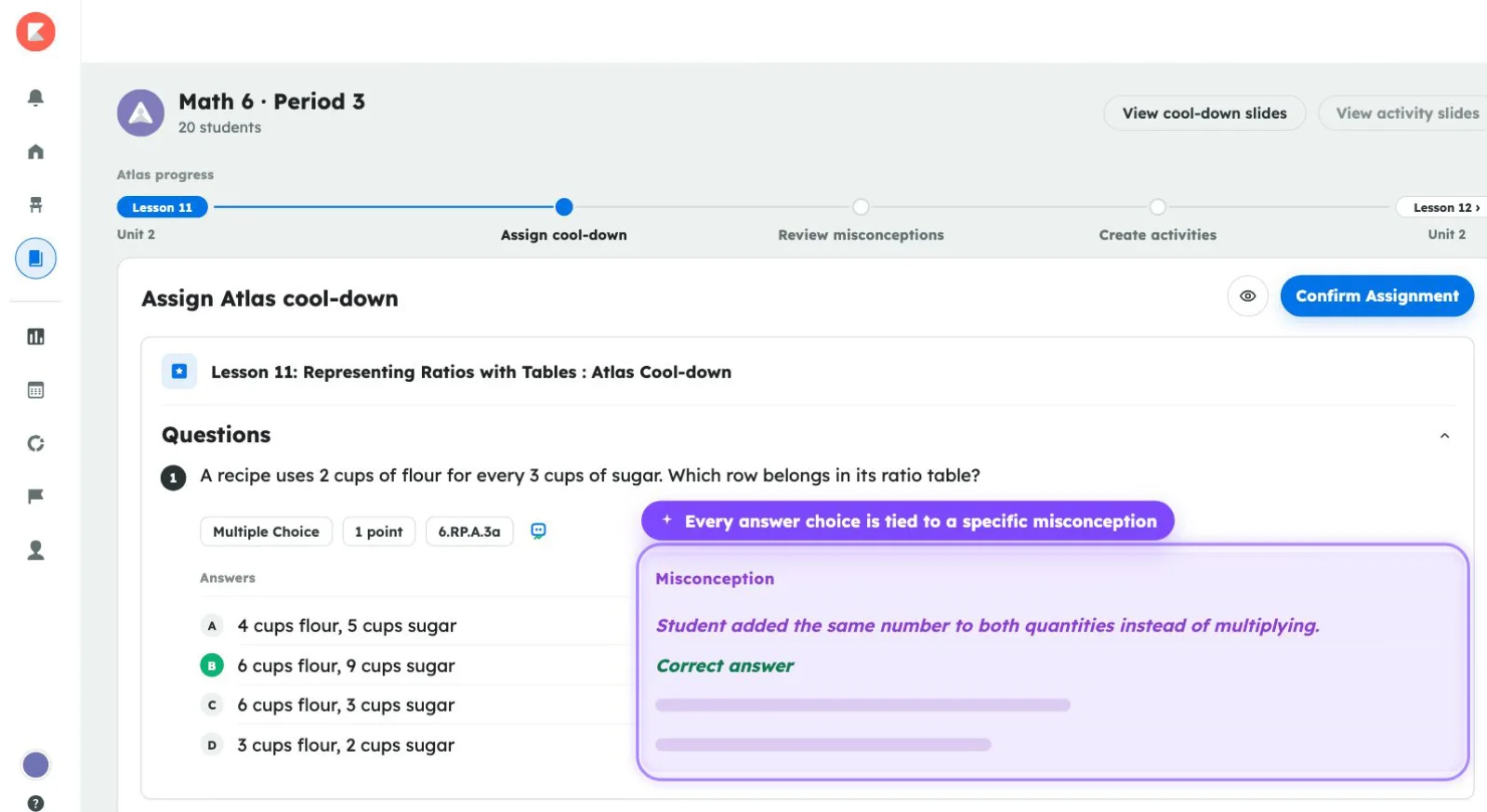
On the Lesson 11 page, choose Atlas Cool-down. You land in the Atlas loop with the cool-down ready to assign. The eye icon shows it exactly as students will see it. Confirm Assignment sends it to the class. Each answer choice is paired with the misconception it reveals, so a wrong answer already says something.

The Assign Atlas cool-down panel for Math 6, Period 3, with an eye icon and a Confirm Assignment button. The Atlas progress bar runs from Lesson 11 through Assign cool-down, Review misconceptions, and Create activities to Lesson 12. The Lesson 11 Representing Ratios with Tables Atlas Cool-down asks: A recipe uses 2 cups of flour for every 3 cups of sugar. Which row belongs in its ratio table? A callout reads: Every answer choice is tied to a specific misconception. Answer A, 4 cups flour, 5 cups sugar, is paired with: Student added the same number to both quantities instead of multiplying. Answer B is the correct answer.
From our Atlas overview video, a simplified view of the Atlas screens. Answer A is Jackson’s mistake from earlier, written as a choice. The progress bar across the top is the whole loop: assign, review, create.

Review misconceptions

Grouped by the reason, with the evidence

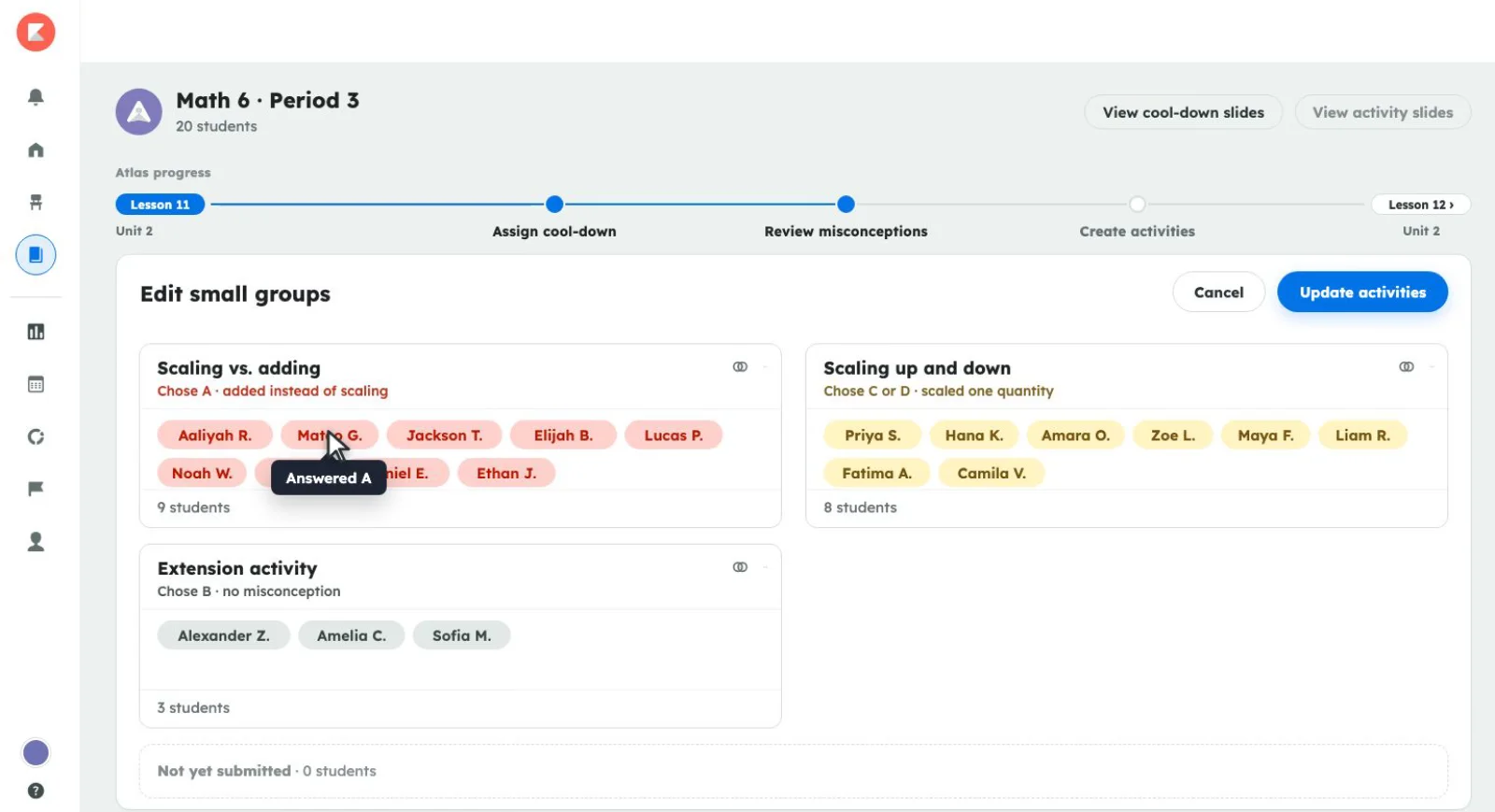
As answers come in, Atlas places each student in a group named for the misconception, with the evidence on the card: which answer they chose and what it shows about their thinking. A coach note on each group explains what the error reveals and what to know before you address it. In this class of 20, nine students added instead of scaling, eight scaled only one quantity, and three answered correctly and go to an extension activity. Students who have not submitted wait in their own row.

Six seconds from the Atlas overview video, simplified to two misconception groups. Scaling vs. adding is Group 1, the students who scaled only one quantity are Group 2, and Extension activity is Group 3. The fuller demo class for this lesson splits Group 2 into Same factor for both and Scaling up and down.

Edit small groups

You know things Atlas doesn’t

Atlas recommends the groups. You decide. Hover a student to see what they answered, then drag them to another group if you know better. Maybe Mateo chose the adding answer but talked through scaling in class yesterday. Move him, choose Update activities, and Atlas rebuilds the activities to match.

The Edit small groups view in Atlas, with Cancel and Update activities buttons. The Scaling vs. adding card lists nine students; a tooltip on Mateo G. reads Answered A. The Scaling up and down card lists eight students and the Extension activity card lists Alexander Z., Amelia C., and Sofia M.
Edit small groups. Every card can be changed before any activity is created.

Atlas Activities

The next Do Now, one per group

Atlas recommends how to respond and explains its reasoning. Small-group interventions give each misconception group a mini lesson, focused practice, and an exit check. A whole-class reteach fits when most students share the same gap. Individual practice matches each student to their own error. You choose the path, or take your own, and Atlas prepares the materials.

Students who are ahead get open-ended enrichment within the same standard, and students on track get spiral review and a preview of the next lesson. No one is pushed into content you haven’t taught. All of it becomes the Do Now that opens the next lesson, never part of the lesson’s grade-level activities.

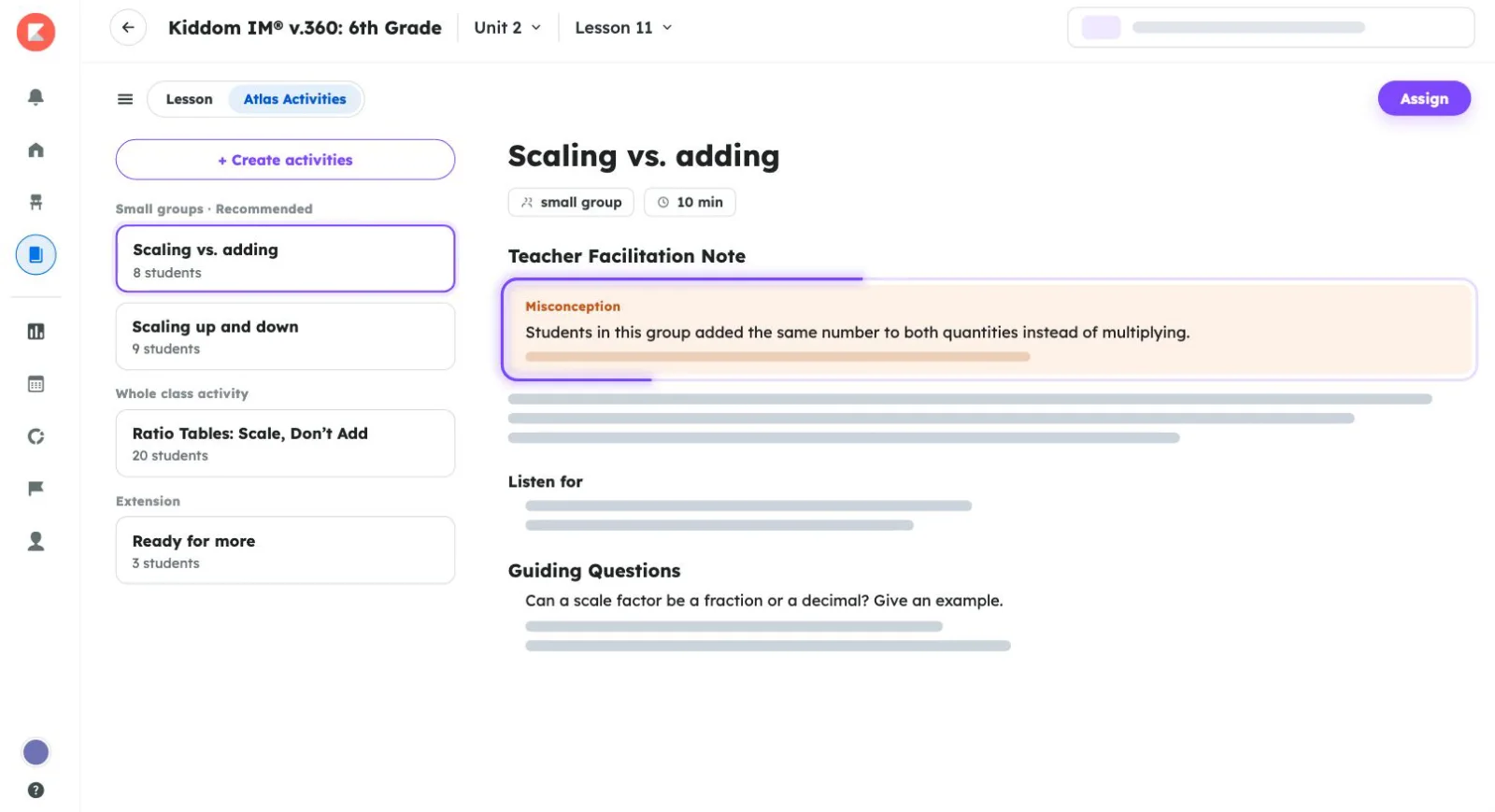
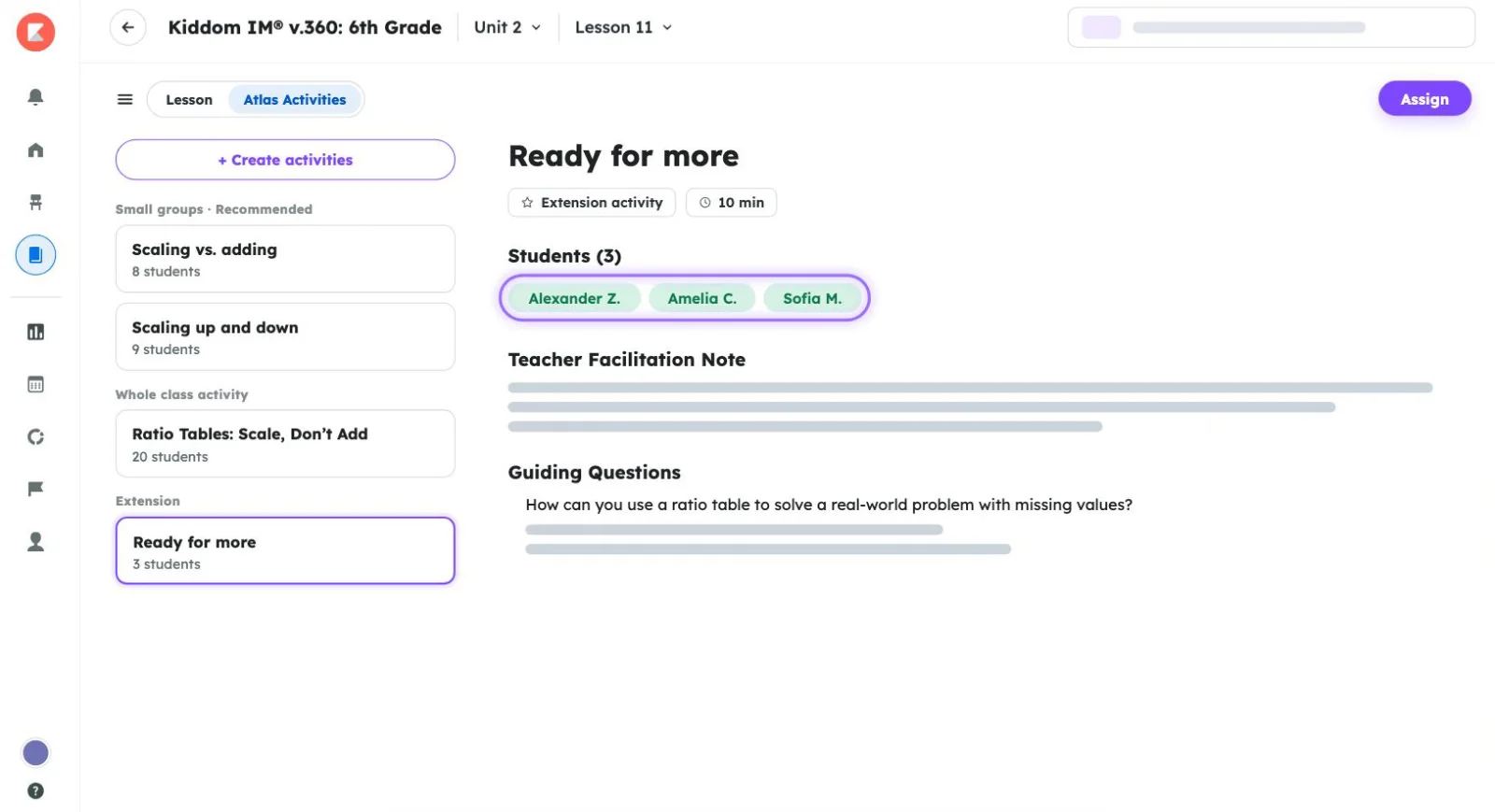
Atlas Activities for Lesson 11. The selected small group, Scaling vs. adding, 10 minutes, opens a Teacher Facilitation Note whose Misconception callout reads: Students in this group added the same number to both quantities instead of multiplying. Listen for and Guiding Questions sections follow. The Ready for more extension activity in Atlas Activities, 10 minutes, assigned to three students: Alexander Z., Amelia C., and Sofia M. A guiding question reads: How can you use a ratio table to solve a real-world problem with missing values?
Left: the facilitation note for the Scaling vs. adding group. Right: the extension for the three students ready for more.
16.4%

In NYC District 11, the first district to adopt Atlas, Grade 7 students in classrooms that used Atlas exit tickets most scored 16.4% higher on end-of-unit math assessments than students in low-usage classrooms, about five additional months of learning.

Source: Atlas Impact, Kiddom. Heavy use means more than 25 Atlas exit tickets.

Questions teachers ask

Short answers to the questions that come up most about exit ticket data and small groups. The examples come from Kiddom Math Grade 6, Unit 2.

What should I do with exit ticket data?

Sort the tickets by the reason students missed, not by their score, into three groups: a shared misconception, almost there, and ready for more. Use the first ten minutes of the next class as a grouped Do Now, with one targeted task per group, then move the whole class into the new lesson. The next exit ticket tells you whether it worked.

How do I group students after a formative assessment?

Read each wrong answer for the move behind it, not just the number right. Group students who made the same mistake for the same reason, students who have the idea but slip on one step, and students who answered correctly and can explain why. Keep the groups for one day and rebuild them from the next check.

How many groups should I use for small-group instruction?

Three is a good default, and it is what one teacher can run at once: one group at the teacher table and two working independently. Split a group only when its students need different next steps. In Kiddom Math, Atlas by Kiddom creates as many groups as the evidence calls for, and the teacher can change any of them.

What is the difference between an exit ticket and a cool-down?

They do the same job. A cool-down is the name Kiddom Math uses for the short task at the end of every lesson, written by the curriculum authors to check that lesson's main idea. Each cool-down also comes with guidance on how to respond: More Chances, Points to Emphasize, or Press Pause.

How long should a small-group Do Now take?

About ten minutes, the length of a typical warm-up. That is long enough for one focused conversation at the teacher table and one task for each other group, and short enough that every student still gets the full grade-level lesson. In Kiddom Math Grade 6, Lesson 12 opens with exactly a 10-minute warm-up slot.

What tools group students by need after an exit ticket?

Many tools group students by score; fewer group them by the reason behind the answer. In Kiddom Math, Atlas by Kiddom reads each cool-down within minutes of submission, identifies the misconception behind each wrong answer, and groups students who share it, with the evidence for each group. It recommends a response and explains why; the teacher chooses the path, can change any group, and Atlas prepares the materials for the next Do Now.

How do I know if the small group worked?

Check the next exit ticket, and read the grouped students' answers first. If students who shared a misconception now reason correctly in a new context, the group is done; if a few still make the same move, they become the next day's teacher table. Act before the next class rather than waiting for the unit test.


If you want to read further

Research and practice

  • Black, P., & Wiliam, D. (1998). Inside the black box: Raising standards through classroom assessment. Phi Delta Kappan, 80(2), 139–148. The case that formative assessment only works when it changes the teaching that follows.
  • Wiliam, D. (2011). Embedded Formative Assessment. Solution Tree Press. Practical techniques for using evidence of learning within the next lesson, not the next unit.
  • Fisher, D., & Frey, N. (2007). Checking for Understanding: Formative Assessment Techniques for Your Classroom. ASCD. Exit slips and other quick checks, and what to do with them.
  • Smith, M. S., & Stein, M. K. (2011). 5 Practices for Orchestrating Productive Mathematics Discussions. NCTM. Anticipating student strategies before class, the same move the curriculum’s Building On Student Thinking notes make.

More from Kiddom

Five minutes, then ten

An exit ticket earns its five minutes when it changes the next ten. Sort by the reason. Keep it to three groups. Spend the opening of the next class on them, then teach the lesson everyone needs, and let the next cool-down tell you what to do the day after. With Atlas, the analysis that used to happen at your kitchen table is done before the next class. You walk in ready.

See how Atlas works