

Mountains move: where the phenomena live in a Kiddom OpenSciEd unit

How a phenomenon-based science curriculum layers anchoring, investigative, and everyday phenomena, shown in a Kiddom OpenSciEd Grade 6 unit on Mt. Everest.
Kiddom Insights abstract geometric pattern in greens
Kiddom logo
Kiddom
October 5, 2026

Mountains move. Your students should get to ask why.

Mt. Everest is getting taller. About 2 centimeters a year. It is also sliding northeast at roughly 4 centimeters a year, and the rock near its summit holds fossils of animals that lived on an ocean floor. Read that to a room of sixth graders and the questions start before you finish the sentence. Why would a mountain grow? What is pushing it? How does an ocean end up on top of the tallest mountain on Earth?

That reaction is the whole point. OpenSciEd is a phenomenon-based science curriculum, built as a storyline: a sequence of lessons motivated by the questions students raise when they meet a phenomenon they cannot yet explain. The hard part for a teacher is not the science. It is knowing, on any given day, which phenomenon is on the table, why it is there, and what it is doing for the larger explanation the class is building.

In plain terms An OpenSciEd unit works with phenomena at three scales. One anchoring phenomenon opens the unit and stays unexplained until the end. Smaller investigative phenomena show up inside individual lessons, and each one explains a piece of the anchor. Students’ own everyday phenomena, the curriculum calls them related phenomena, connect the science to land they have actually seen change. The three layers point at one question.

Kiddom OpenSciEd keeps those layers visible. Every lesson page names the role it plays in the storyline, links back to the lesson before and forward to the lesson after, and states what students will figure out. This post walks through one unit, Grade 6 Unit 6.4 Plate Tectonics & Rock Cycling, and shows where each layer of phenomena is introduced, where it is used, and how a teacher can see all of it before class starts.

Three layers, one explanation

Think of the layers by how much of the unit each one has to carry. The anchoring phenomenon carries all of it. It is rich enough to sustain weeks of work and complex enough that no single science idea can explain it. An investigative phenomenon carries one lesson, sometimes two. It is something students can observe or model directly, and explaining it moves the class one step closer to the anchor. Everyday phenomena carry the connection to students’ lives. They are the hills, shorelines, and cracked ground students already know, and they are the test of whether the science ideas travel beyond Mt. Everest.

What each layer carries in Unit 6.4

AnchoringOne per unit
How much of the unit it carries

Mt. Everest grows, moves, shook in a 2015 earthquake, and has marine fossils near its summit. Four other mountains are changing too, and some are shrinking.

Introduced Lesson 1, Day 1. Used every lesson, through the Driving Question Board. Explained Lesson 14.

InvestigativeOne per lesson or two
How much of the unit it carries

An earthquake near Ridgecrest, California cracks the desert floor and shifts a road about 7.5 feet. Later lessons bring in volcanoes, the Mid-Atlantic Ridge, and erosion rates.

Introduced at the start of an Investigation lesson. Used to answer one question on the board. Recorded in the Progress Tracker.

EverydayStudents bring them
How much of the unit it carries

A change students have seen in land near them: a hillside, a shoreline, a sidewalk, a riverbank. Short or long timescale, big or small.

Introduced Lesson 1, Day 3, on the Related Phenomena poster. Used to add questions to the board. Explained Lesson 14, with the science ideas the class earned.

The bar is a rough sense of scope, not a count of minutes. One anchor spans fourteen lessons. An investigative phenomenon answers one question on the Driving Question Board. Everyday phenomena are the smallest in scope and the closest to home, which is why the unit returns to them at the end.

The storyline approach comes from research on what it takes for a unit to feel coherent from the student’s point of view, not just the teacher’s. Students should be able to say why today’s lesson is happening. In OpenSciEd, the answer is always a question the class asked about a phenomenon it has seen. The three layers give students three kinds of reasons to care: the mystery that opened the unit, the specific event in front of them today, and the thing they noticed on the way to school.

One unit, one question, fourteen lessons

Open Grade 6 in Kiddom OpenSciEd and go to Unit 6.4. The unit question is What causes Earth’s surface to change? Fourteen lessons answer it in two sets plus a culminating lesson. Lesson Set 1 works out what makes mountains grow and move. Lesson Set 2 turns to why other mountains change elevation and location, including the ones that are shrinking. Lesson 14 puts the pieces together to explain the fossil.

  1. CourseOpenSciEd Grade 6
  2. Unit 6.4Plate Tectonics & Rock Cycling
  3. Lesson Set 1Lessons 1 to 9
  4. Lesson Set 2Lessons 10 to 13
  5. CulminatingLesson 14

Where the phenomena sit across the unit

  1. Lesson Set 1 · Lessons 1 to 9What causes mountains to grow and move?

    Anchor, then earthquakes, what is below the surface, plate movement and collisions, volcanoes, spreading ridges.

  2. Lesson Set 2 · Lessons 10 to 13What causes other mountains to change?

    Where the continents were, fossils across oceans, mountains far from plate boundaries, erosion versus uplift.

  3. Lesson 14The fossil

    Answer the unit question.

  1. 1
  2. 2
  3. 3
  4. 4
  5. 5
  6. 6
  7. 7
  8. 8
  9. 9
  10. 10
  11. 11
  12. 12
  13. 13
  14. 14
Anchoring phenomenon Investigation lessons Putting pieces together Related (everyday) phenomena poster in use
The anchor opens the unit and is explained in the last lesson. Everything in between is an investigation of a smaller phenomenon that answers one of the questions on the Driving Question Board. The Related Phenomena poster goes up on Day 3 of Lesson 1 and comes back down, explained, in Lesson 14.
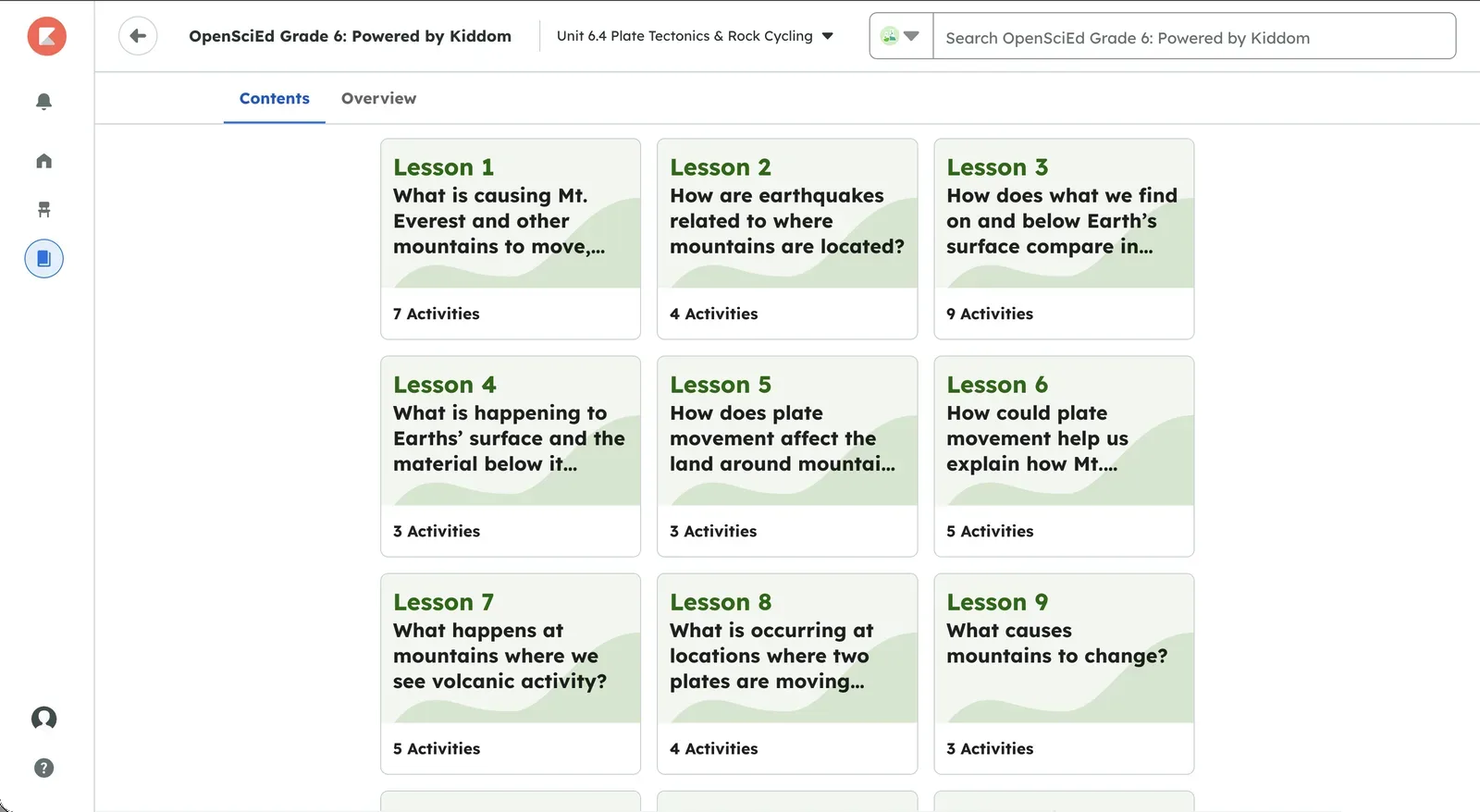
The Unit 6.4 Plate Tectonics & Rock Cycling page in Kiddom OpenSciEd Grade 6, Contents tab. Lessons 1 to 9 appear as cards, each titled with its question: What is causing Mt. Everest and other mountains to move, grow, or shrink? How are earthquakes related to where mountains are located? How does what we find on and below Earth's surface compare in different places? Each card shows its activity count.
Unit 6.4 in Kiddom, Contents tab. Every lesson card is titled with its question, so the storyline reads as a storyline before you open a single lesson.

Where each layer lives in a lesson

Choose a layer to see the lesson where it is introduced, the phenomenon as students meet it, and what the Kiddom lesson page tells you about it before you teach. Each layer also has a short video. The videos were made for this post to help you picture the phenomenon. They are not part of the OpenSciEd curriculum.

Lesson 1: What is causing Mt. Everest and other mountains to move, grow, or shrink?

Anchoring: the mountain that grows

Illustration

Not part of the curriculum. This clip was generated for this post to help you picture the phenomenon. In class, students meet Mt. Everest through a headline, a reading, and data cards.

The phenomenon, as students meet it Mt. Everest, the tallest mountain on Earth, is growing. New data collected together by Nepal and China show the summit rising about 2 centimeters a year and drifting northeast about 4 centimeters a year. It is roughly 30 feet taller than it was in 1856. A large earthquake struck the mountain in 2015. Scientists are not sure whether the earthquake changed its height. And there are fossils of ocean animals in the rock near the top.

Day 1.You read the headline off slide A. Students turn and talk about what could make a mountain grow, find Everest on the World Map and on squish-ball globes, then read What is happening on Mount Everest? with a partner and fill a notice-and-wonder chart. By the end of the day the class has drawn an initial model of what might be pushing the mountain up and sideways.

Day 2.Everest is one mountain. Students get data cards for four more peaks around the world and build a table: height, movement, change in height, earthquake activity. Some of the mountains are shrinking. That fact matters later.

Days 3 and 4.Students model a shrinking mountain, brainstorm related phenomena from their own lives, and write the questions that become the Driving Question Board. The board is the anchor’s memory. Every lesson that follows starts by asking which question the class can work on next.

Why this anchor.The teacher notes say it out loud: the anchor pairs a change too slow to see, a mountain growing, with a change you cannot miss, an earthquake. It asks about one event and a pattern of events at the same time. Students need more than one science idea to explain it, so the unit has room to run.
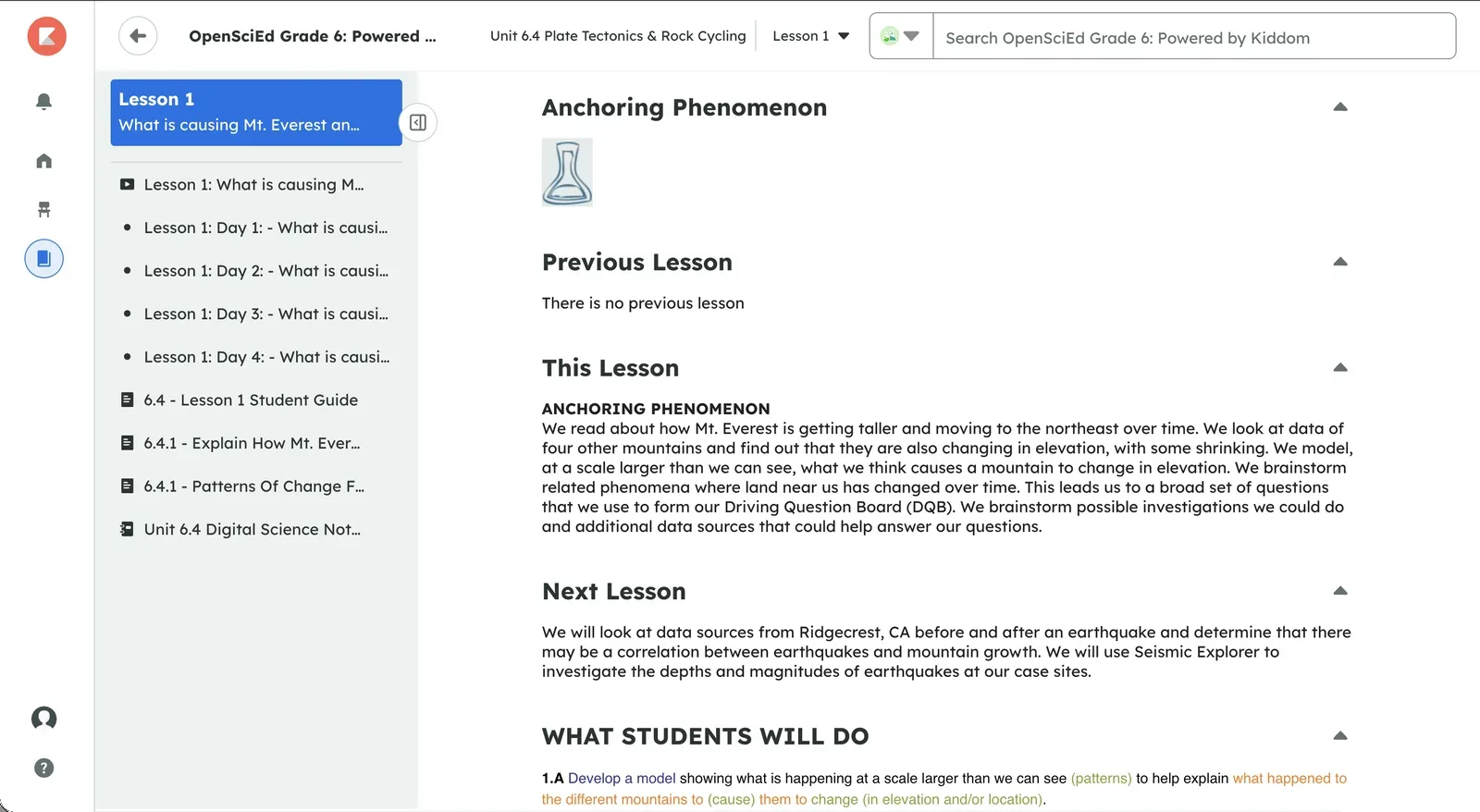
The Kiddom OpenSciEd page for Lesson 1. The section label reads Anchoring Phenomenon. Previous Lesson says there is no previous lesson. The This Lesson note reads: Anchoring Phenomenon. We read about how Mt. Everest is getting taller and moving to the northeast over time. We look at data of four other mountains and find out that they are also changing in elevation, with some shrinking. Next Lesson previews Ridgecrest, CA earthquake data and Seismic Explorer. The left sidebar lists Lesson 1 Days 1 to 4, the Student Guide, two handouts, and the Unit 6.4 Digital Science Notebook.
Lesson 1 in Kiddom. The label at the top says Anchoring Phenomenon. The This Lesson note summarises the anchor in six sentences, and Next Lesson already points at Ridgecrest. The sidebar shows the four days, the student guide, and the science notebook on one page.

Lesson 2: How are earthquakes related to where mountains are located?

Investigative: the ground that cracked

Illustration

Not part of the curriculum. This clip was generated for this post. In class, students watch footage from a hotel camera, look at a USGS geologist’s photos of the broken ground, and compare satellite images from before and after.

The phenomenon, as students meet it An earthquake struck near Ridgecrest, California, a desert valley between four mountain ranges. The ground cracked open. Where the crack crossed a road, the road shifted about 7.5 feet, or 2.5 meters. The ground on one side of the break no longer lines up with the ground on the other. Satellite images from more than a year earlier show the same land before it moved.

Why Ridgecrest.The class wanted to know whether earthquakes cause mountains to change or just happen near them. Students first watch a climber’s video from the 2015 Everest earthquake and hear that the ground moved back and forth. That is not enough. Nobody can tell from a video whether a mountain that tall ended up somewhere new. So the lesson moves to flatter ground where the evidence is easier to read.

Scale, on purpose.Students look at the same rupture at eye level, from above, and from a satellite. The lesson asks them to say what each scale lets them see. You lay three meter sticks on the floor to show how far the road moved.

What it earns.By Day 2 students have used Seismic Explorer to map earthquake depth and magnitude at their case sites, and they can say three things: the ground moves back and forth in an earthquake, the surface can crack with a noticeable offset, and earthquakes happen on or near almost every mountain range. That is one question answered on the board and one new one raised, which is what is happening underground.

The pattern repeats.Lesson 7 does the same thing with volcanoes. Lesson 13 does it with erosion rates. Each Investigation lesson brings in one smaller phenomenon, and each one explains a piece of Everest.

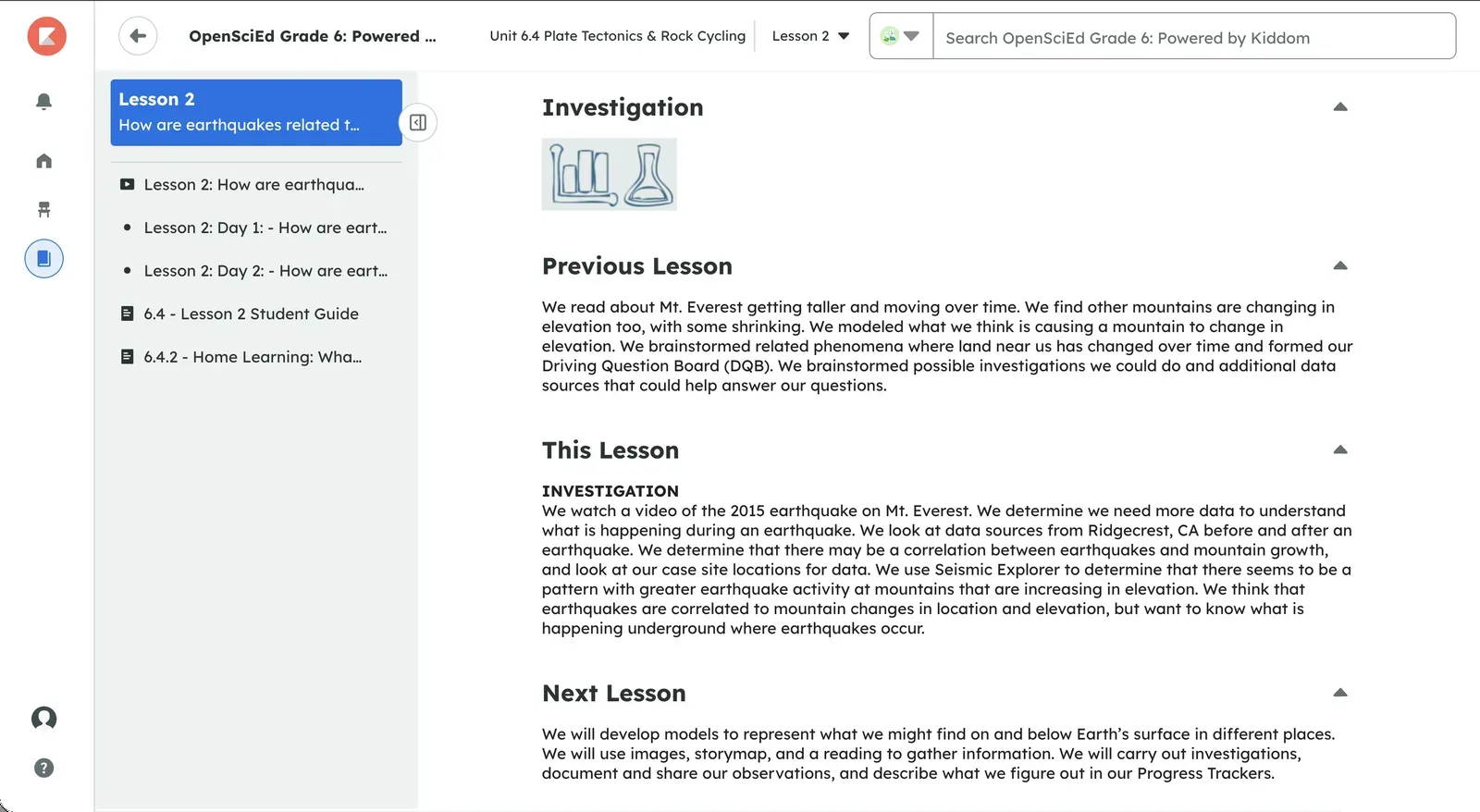
The Kiddom OpenSciEd page for Lesson 2. The section label reads Investigation. Previous Lesson recaps Lesson 1. The This Lesson note reads: Investigation. We watch a video of the 2015 earthquake on Mt. Everest. We determine we need more data to understand what is happening during an earthquake. We look at data sources from Ridgecrest, CA before and after an earthquake. We use Seismic Explorer to determine that there seems to be a pattern with greater earthquake activity at mountains that are increasing in elevation. Next Lesson previews models of what is on and below Earth's surface.
Lesson 2 in Kiddom. The label says Investigation. Previous Lesson and Next Lesson sit on the same page, so you can see the question this investigation answers and the one it hands to Lesson 3.

Lesson 1, Day 3: Brainstorm related phenomena · Lesson 14: Explain related phenomena

Everyday: the land students know

Illustration

Not part of the curriculum. This clip was generated for this post to show one kind of example a student might add to the poster, in the spirit of “Rocks eroding by beaches” from the reference photo in the teacher guide. Students bring their own.

The prompt, as students hear it Think back on all your experiences where you have noticed a change in the surface of the land or landforms, such as hills, mountains, shorelines, or other features on Earth’s surface. These changes could be over a very short period of time or a long period of time, and they could be big or small. If you cannot think of one where you live, a change you saw somewhere you visited or read about counts too.
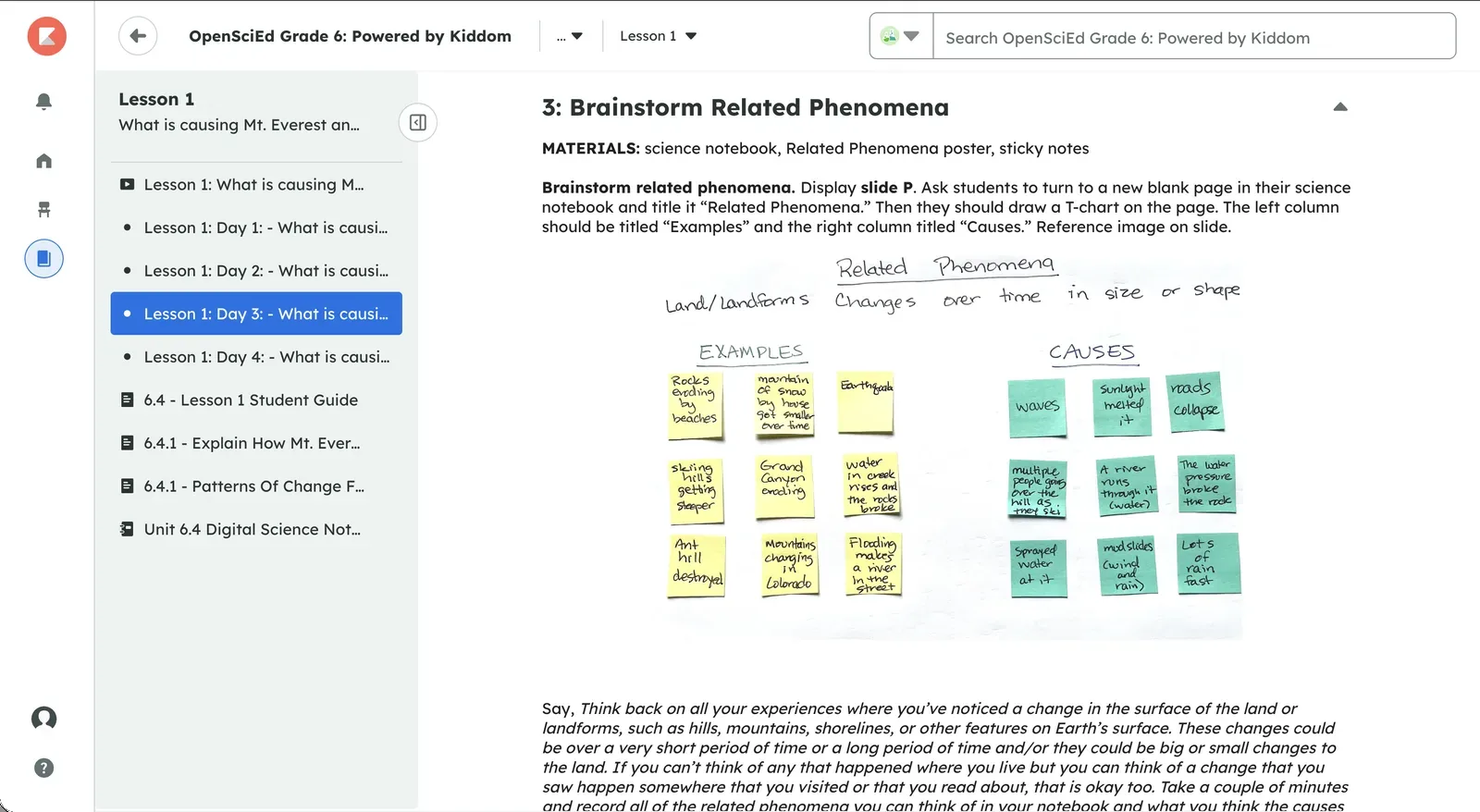
The teacher guide shows one class’s finished poster. Under Examples: rocks eroding by beaches, the Grand Canyon eroding, flooding making a river in the street, mountains changing in Colorado. Under Causes: waves, a river running through it, lots of rain fast. The video shows the first of those, a shoreline bluff after a storm.

Day 3 of Lesson 1.Students title a notebook page Related Phenomena and draw a T-chart: Examples on the left, Causes on the right. They write down every change to land they can remember, share with a partner, and ask whether the cause might be the same thing that is changing Everest. You record each example on a sticky note and add it to the Related Phenomena poster.

Why sticky notes.The teacher notes are specific. In this unit the poster is built from sticky notes so ideas can move. As the class figures out which changes are correlated and which are caused, some examples turn out to belong under a different cause, and students move them.

Lesson 14.The poster comes back. The class has a chain of events for how Earth’s surface changes, and the first thing students do with it is explain their own phenomena. The teacher notes call this one of the exciting things about developing a set of general science ideas. Rocks eroding at a beach, a canyon getting deeper, a street that turned into a river. Students can now say what did it.

What it does for the unit.This is the layer that makes the science portable. Everest is far away. The poster is not. When students can explain the land near them with the same ideas that explain the Himalayas, the unit has done its job.

The Kiddom OpenSciEd Learning Plan for Lesson 1, Day 3, step 3: Brainstorm Related Phenomena. The materials line lists science notebook, Related Phenomena poster, sticky notes. A reference photo shows a completed poster titled Related Phenomena, Land/Landforms Changes over time in size or shape, with yellow sticky notes under Examples such as Rocks eroding by beaches, Grand Canyon eroding, Flooding makes a river in the street, and Mountains changing in Colorado, and green sticky notes under Causes such as waves, a river runs through it, and lots of rain fast. Below, the teacher script begins: Think back on all your experiences where you've noticed a change in the surface of the land or landforms.
Lesson 1, Day 3 in Kiddom. The Learning Plan is written as numbered steps with the materials for each step on its own line, and the teacher guide includes a reference photo of one class’s finished poster, so you know what the sticky notes tend to say before you walk in.

The fossil, explained

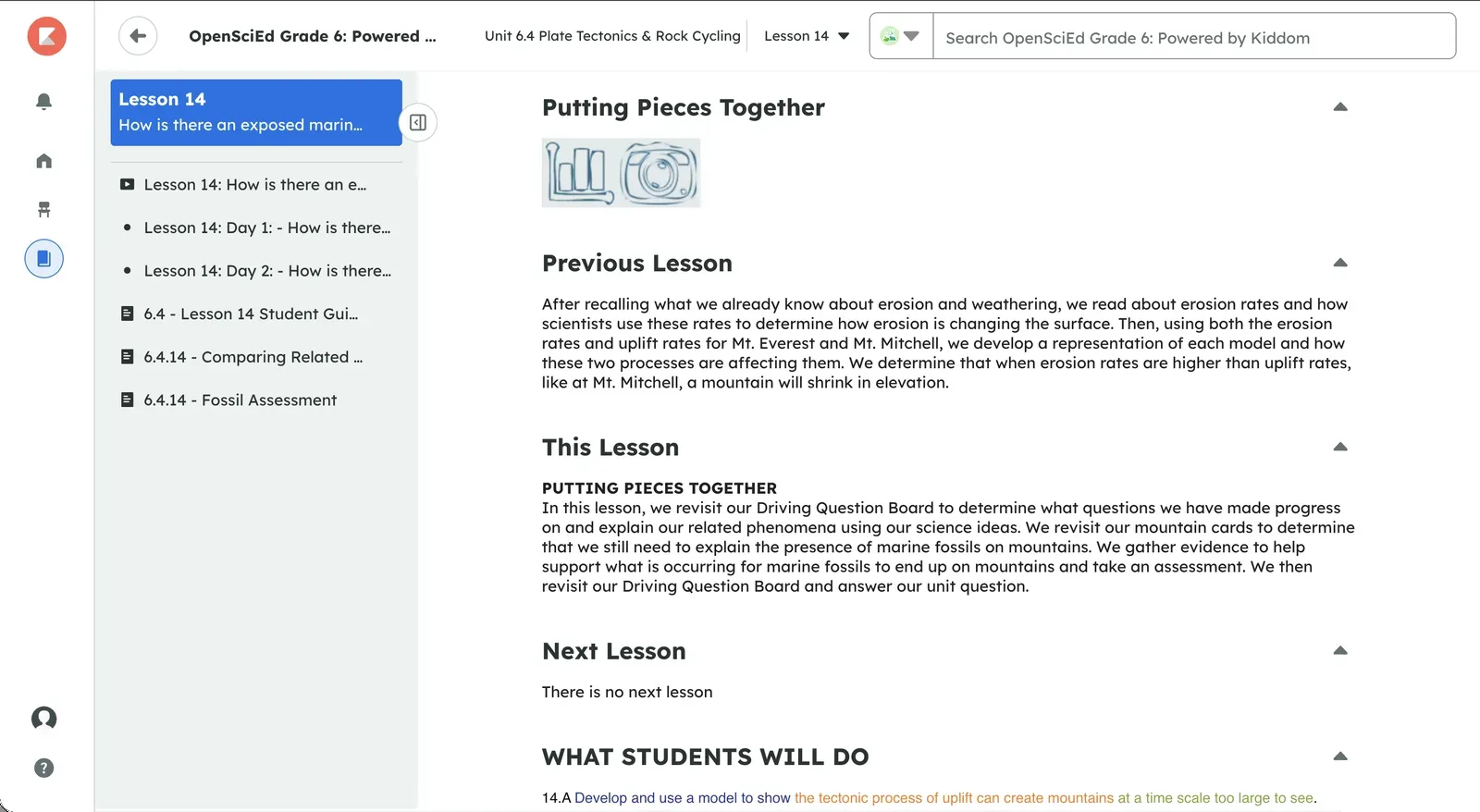
Lesson 14 is where the layers meet. Students revisit the Driving Question Board and mark the questions they can now answer. Most of them. Then they go back to the mountain cards from Lesson 1 and find the one thing still unexplained: there are marine fossils on these mountains. On Day 2 they gather the evidence from their notebooks and take an assessment that asks them to explain it.

The explanation uses everything the investigations earned. Plate movement caused uplift that pushed up rock from an ancient seafloor. Erosion, which students measured against uplift in Lesson 13, exposed the fossils. And erosion keeps going, so one day the fossils will not be there. Then the class answers the unit question, What causes Earth’s surface to change?, and the anchor that opened the unit is closed.

The Kiddom OpenSciEd page for Lesson 14. The section label reads Putting Pieces Together. Previous Lesson recaps erosion and uplift rates for Mt. Everest and Mt. Mitchell. The This Lesson note reads: Putting Pieces Together. In this lesson, we revisit our Driving Question Board to determine what questions we have made progress on and explain our related phenomena using our science ideas. We revisit our mountain cards to determine that we still need to explain the presence of marine fossils on mountains. Next Lesson says there is no next lesson. The sidebar lists the Fossil Assessment.
Lesson 14 in Kiddom. The label says Putting Pieces Together, and the summary names both the related phenomena and the fossil, the two threads that were opened in Lesson 1.

What you can see before you teach

OpenSciEd names five routines that lessons cycle through: Anchoring Phenomenon, Navigation, Investigation, Problematizing, and Putting Pieces Together. In Kiddom OpenSciEd, the routine a lesson belongs to is the first thing on its page. The rest of the page is built so you can answer the question a coherent storyline depends on, which is why this lesson, today.

The parts of every Kiddom OpenSciEd lesson page

Routine label

Anchoring Phenomenon, Investigation, or Putting Pieces Together. One glance tells you which layer of phenomena is in play.

Previous Lesson, This Lesson, Next Lesson

Three short notes that place the lesson in the storyline. The This Lesson note is the phenomenon and the plan in one paragraph.

What Students Will Do and What Students Will Figure Out

The activity and the science idea, kept separate so you can check the second without re-reading the first.

Where We Are Going and Not Going

What the anchor is probing, which prior ideas the unit will lean on, and what to leave alone for now.

Learning Plan by day

Numbered steps with a materials line for each, the teacher talk in italics, and the slide letter to show. Lesson 1 runs four days.

Presentation, Activities, Notebooks, Attachments

The slide deck, the student guide, the science notebook pages, and the Learning Plan Snapshot PDF, on the same page as the plan.

None of this is new content. It is the OpenSciEd teacher guide, laid out so that the storyline is visible on every page rather than in a separate document.

That layout is what makes the three layers teachable. You do not have to remember that the Related Phenomena poster goes up on Day 3 of Lesson 1. It is step 3 in the plan for that day, with the sticky notes on the materials line. You do not have to look up whether Lesson 2 is an investigation or a synthesis. The label says so. And when a student asks why the class is looking at a road in California, the Previous Lesson note has the answer: because last time, you all decided you needed to see an earthquake somewhere flatter than Everest.

Questions teachers ask

Short answers to the questions that come up most about phenomenon-based science and where the phenomena live in a unit. The examples come from Grade 6 Unit 6.4.

What is a phenomenon-based science curriculum?

A phenomenon-based science curriculum organizes learning around observable, real-world events that students work to explain, rather than topics taught one after another. Students meet a phenomenon they cannot yet explain, ask questions about it, and build the science ideas they need to figure it out. OpenSciEd is one example, built as a storyline in which each lesson is driven by a question students raised about a phenomenon.

What is an anchoring phenomenon?

An anchoring phenomenon is the single observable event that opens a unit and stays unexplained until the end. It is complex enough that no one science idea can explain it, so it can sustain weeks of investigation. In Kiddom OpenSciEd Grade 6 Unit 6.4, the anchor is that Mt. Everest is growing about 2 centimeters a year, sliding northeast, and holds fossils of ocean animals near its summit.

What is the difference between anchoring, investigative, and everyday phenomena?

An anchoring phenomenon carries a whole unit. Investigative phenomena are smaller events students examine inside a single lesson, and each one explains a piece of the anchor. Everyday phenomena are changes students have seen in their own lives; OpenSciEd calls these related phenomena, and the three-layer anchoring, investigative, and everyday language follows Brett Moulding. In Unit 6.4 the anchor is Mt. Everest, an investigative phenomenon is an earthquake that shifted a California road about 7.5 feet, and the everyday phenomena are the eroding hillsides and shorelines students add to a class poster.

How does OpenSciEd use phenomena?

OpenSciEd introduces one anchoring phenomenon at the start of a unit and records students' questions on a Driving Question Board. Each lesson that follows investigates a smaller phenomenon that answers one of those questions, and the unit ends by putting the pieces together to explain the anchor. Lessons cycle through five named routines: Anchoring Phenomenon, Navigation, Investigation, Problematizing, and Putting Pieces Together.

Is OpenSciEd aligned to NGSS and three-dimensional learning?

Yes. OpenSciEd is designed for the Next Generation Science Standards, and its units build the three dimensions together: science and engineering practices, disciplinary core ideas, and crosscutting concepts. Unit 6.4 Plate Tectonics and Rock Cycling addresses performance expectations MS-ESS1-4, MS-ESS2-1, MS-ESS2-2, and MS-ESS2-3.

What does Kiddom add to OpenSciEd?

Kiddom OpenSciEd keeps the storyline visible on every lesson page. Each page names the routine the lesson belongs to, links to the previous and next lesson, and states what students will figure out, so a teacher can see which phenomenon is in play and why before class starts. In the app the course is titled OpenSciEd Grade 6: Powered by Kiddom.

If you want to read further

  • OpenSciEd. Instructional Model. The storyline approach and the five lesson-level routines. openscied.org
  • OpenSciEd. How are phenomena used in OpenSciEd units? What makes a phenomenon a good anchor, including everyday phenomena that puzzle students. openscied.org
  • OpenSciEd. 6.4 Plate Tectonics & Rock Cycling. The public unit page: unit question, lesson sets, and performance expectations MS-ESS1-4, MS-ESS2-1, MS-ESS2-2, MS-ESS2-3. openscied.org
  • Reiser, B. J., Novak, M., McGill, T. A. W., & Penuel, W. R. (2021). Storyline units: An instructional model to support coherence from the students’ perspective. Journal of Science Teacher Education, 32(7), 805–829.
  • Moulding, B. Teaching Science Is Phenomenal. The distinction between anchoring, investigative, and related phenomena used in this post.

One question, three ways in

A sixth grader who spends six weeks on Unit 6.4 never studies plate tectonics as a topic. They explain a mountain. Along the way they explain a cracked road, a line of volcanoes, a ridge in the middle of the Atlantic, and whatever they wrote on a sticky note in the first week. The anchor gives the unit a reason. The investigations give it steps. The everyday phenomena give it a reason to matter after the unit ends. Kiddom OpenSciEd keeps all three in view so the storyline students experience is the one you can see on the page.

See it in action