Kiddom
October 2, 2026


Building Thinking Classrooms (BTC) is an instructional approach from Peter Liljedahl that has students solve problems together on vertical whiteboards in visibly random groups, so they do the reasoning instead of watching a demonstration. In Georgia, it fits well with Georgia’s K-12 Mathematics Standards and their emphasis on mathematical thinking, reasoning, and deeper mastery of concepts. BTC is a teaching approach, not a curriculum, so teachers still need worthwhile tasks and daily evidence of student understanding.
Kiddom Georgia Math provides both for K-Algebra 1. It is aligned to Georgia’s K-12 Mathematics Standards and GaDOE Inspire Learning Progressions, and crosswalked to Inspire’s Instructional Learning Plans. Teachers keep control of grouping, workspace, and facilitation.
Liljedahl's research produced a set of 14 classroom practices organized around a single goal: make students the ones doing the thinking. Three of the most recognizable practices are using vertical erasable surfaces where work stays visible and easy to revise, forming visibly random groups so students cannot settle into fixed roles, and launching tasks that demand genuine reasoning rather than procedure retrieval.
Across all 14 practices, the pattern is similar: the teacher's role shifts toward observation, questioning, and strategic hint-giving, while students' responsibility shifts toward making sense of the problem, noticing how a peer's approach differs from their own, and articulating why a strategy works.
For Georgia districts, what matters most is how the core curriculum positions teachers to make those instructional choices. BTC does not provide a curriculum or scope and sequence. Instead, it offers practices for choosing and launching thinking tasks, organizing students and their workspace, responding to questions, and consolidating learning. Kiddom Georgia Math provides the grade-level tasks, lesson sequence, and curriculum structure teachers can use within those practices. Decisions about how to group students, where they work, which strategies to surface in discussion, and how to sequence those strategies belong to the teacher.
Keeping that boundary clear is important for Georgia districts evaluating both a curriculum and a professional learning approach. BTC is a research-based framework for how teachers organize classroom conditions; it does not arrive with its own scope and sequence. The curriculum provides the grade-level content and sequence; BTC provides practices for how teachers create the conditions for students to think. The two work together when the curriculum provides tasks rich enough to support genuine inquiry and the teacher has the latitude to facilitate discussion around what students produce.
Kiddom Georgia Math is aligned to Georgia's K-12 Mathematics Standards and Georgia's Inspire learning progressions. The standards are designed to present a reasonable amount of content each year so students can master concepts rather than be quickly exposed to them, and GaDOE also emphasizes helping students develop positive mathematics mindsets and dispositions.
Those goals fit a thinking classroom. Depth over coverage leaves room for students to struggle productively, compare approaches, and explain why a strategy works. Kiddom Georgia Math is crosswalked to Inspire's Instructional Learning Plans, so teachers can use GaDOE Inspire resources and Kiddom lessons together without working across two disconnected frameworks.
Kiddom Georgia Math student workbooks include lesson warm-ups, activities, and practice problems, and each lesson ends with a short cool-down. The lesson synthesis brings student thinking into a whole-class conversation. A warm-up gives students something to notice or wonder about. Activities let them work through tasks and meet the ideas the lesson builds toward. The cool-down gives each student an individual check before the next day begins.
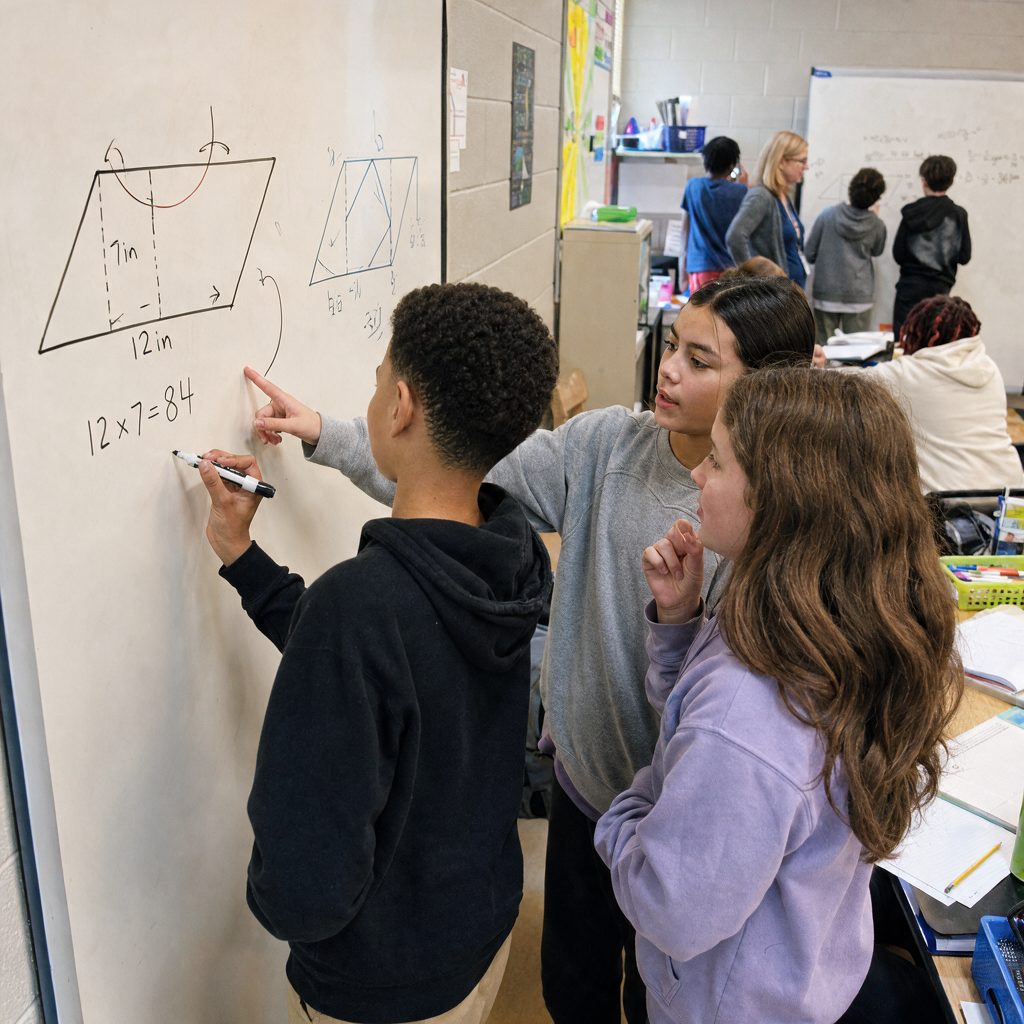
Each stage gives a teacher a place to apply BTC practices. A teacher might launch an activity with visibly random groups at vertical whiteboards, then use the cool-down to see what each student understood independently. In a Georgia Math Grade 6 lesson on parallelograms, students are asked to “find the area of each parallelogram and show your reasoning,” with no formula provided. As groups work, some might cut and rearrange a shape into a rectangle, while others might enclose the shape and subtract the extra pieces. When the class compares strategies, the teacher can surface how different representations lead to the same mathematical understanding and use students’ reasoning to build toward the area formula.
Manipulatives support this work. Kiddom offers Manipulative Kits for all grades and Centers Kits for K-5, plus digital manipulatives. Whether a student works with physical tiles or a digital model, the thinking task stays the same, and keeping that task at the center drives the conversation.
A student may understand the math and still need support finding the words to explain it. Kiddom Georgia Math includes embedded supports that help multilingual learners participate in grade-level mathematics, build mathematical language, and communicate their reasoning.
The teacher decides when and how to use these supports. Listening to how students explain their work (what they get right, where the language breaks down, which representations they choose) makes the whole-class discussion worth having. Deciding which student ideas to elevate and how to sequence them is central to sustaining a thinking classroom.
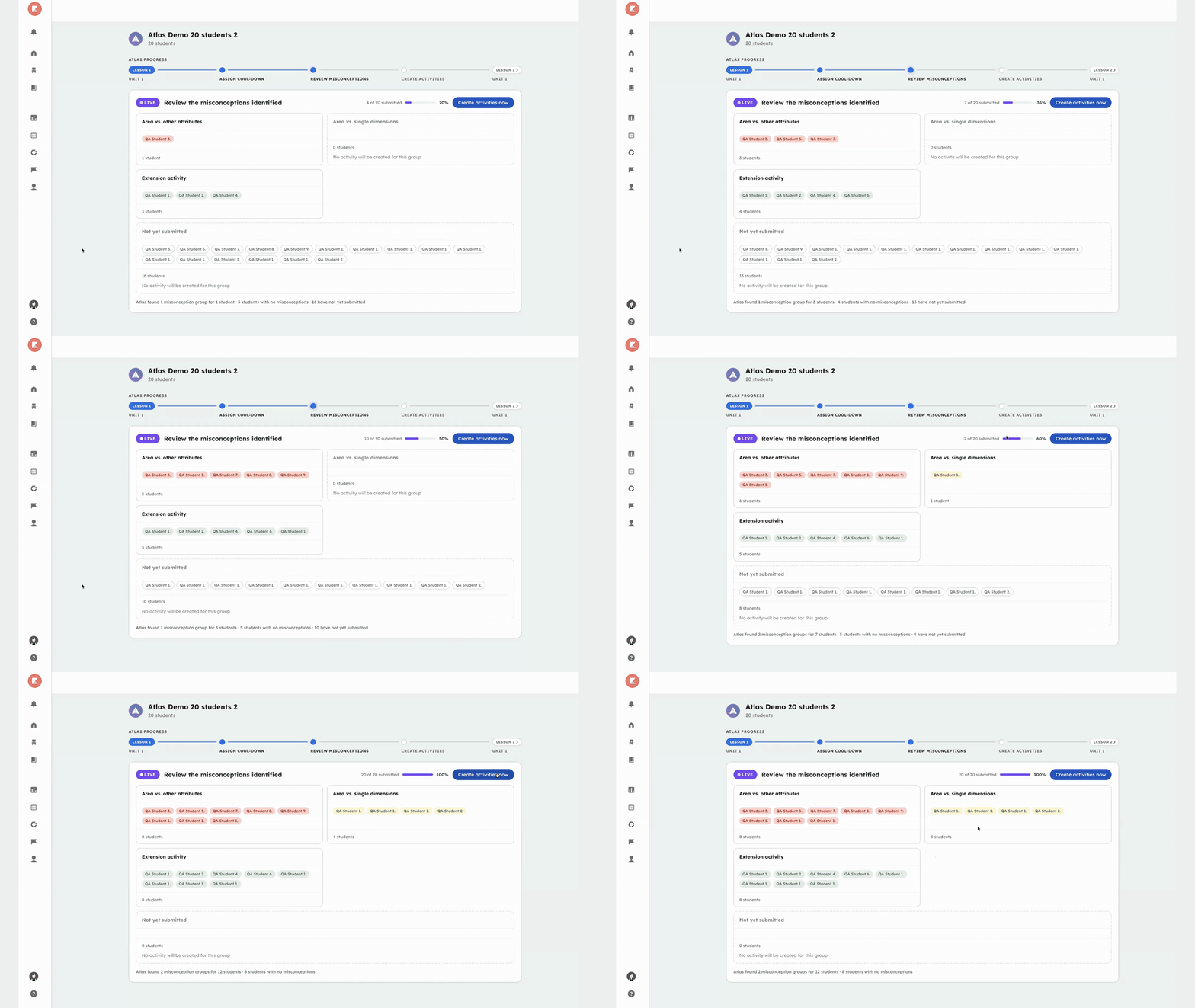
Atlas by Kiddom uses daily cool-down data to identify misconceptions, surface patterns in student understanding, and prepare differentiated next steps. It automatically drafts student groups and targeted Warm-ups, while the teacher reviews and approves what happens next.
Within a GaMTSS framework, daily cool-downs and Warm-ups can strengthen Tier 1 formative assessment, targeted groups can support Tier 2 instruction, and persistent misconceptions can help teachers and interventionists identify where more intensive support may be needed.
The teacher decides whether to run a small group, a whole-class reteach, or individual practice. Atlas then prepares differentiated materials for the next lesson. It can also prepare curriculum-grounded extension activities for students who are ready to go further.
The feedback loop also helps with assessment. Kiddom Georgia Math includes Georgia Milestones-style questions embedded in lessons and assessments that reflect the rigor and question types students encounter on Georgia Milestones. Daily discussion and cool-downs give teachers usable evidence while students are still building understanding, well before Georgia Milestones assessments.
The central question BTC places in front of Georgia educators is straightforward: when the lesson is over, whose thinking did the work? Evidence shows up not just in assessment scores but in what students say to each other during an activity, what they draw or construct at a whiteboard, and whether they can walk through the logic of a strategy they did not originate. Across K–Algebra 1, those moments give teachers evidence that students are making sense of the mathematics rather than simply reproducing a procedure.
Kiddom Georgia Math is designed to make that quality of engagement achievable within the structures Georgia already uses. Lessons aligned to Georgia's standards and Georgia's Inspire learning progressions give teachers tasks worth facilitating. Cool-downs and Atlas by Kiddom turn daily student work into evidence teachers can use within a GaMTSS framework, from strengthening Tier 1 instruction to identifying students who may need more targeted support.
Milestones-style questions embedded throughout give students practice with the rigor and question types they encounter on Georgia Milestones. What the curriculum does not prescribe is how teachers organize groups, where students work, or which student ideas to bring forward: those are the instructional moves where BTC practices take hold and where Georgia teachers exercise professional judgment.
What is Building Thinking Classrooms? Building Thinking Classrooms is a research-based instructional framework developed by Peter Liljedahl after studying what keeps students genuinely engaged in mathematical reasoning. It describes 14 practices, ranging from how tasks are launched to how answers are withheld to how groups are formed, that together shift classroom activity so students are the ones constructing understanding rather than receiving it. The framework is not a curriculum; it is a set of conditions teachers can create around whatever curriculum they use.
Does Kiddom Georgia Math support Building Thinking Classrooms? Kiddom Georgia Math gives teachers problem-based lessons with warm-ups, activities, and daily cool-downs, plus manipulatives, that a teacher can use to create the student discourse BTC calls for. Grouping, workspace, and facilitation remain the teacher's decisions.
How does Kiddom Georgia Math align to Georgia standards? It is aligned to Georgia’s K-12 Mathematics Standards and GaDOE Inspire Learning Progressions, and crosswalked to Inspire’s Instructional Learning Plans. It covers K-Algebra 1, with an enhanced Algebra: Concepts and Connections option for Grade 8.
Does Kiddom Georgia Math prepare students for Georgia Milestones? It includes Milestones-style questions embedded in lessons and assessments that reflect the rigor and question types students encounter on Georgia Milestones.
How does Kiddom Georgia Math support GaMTSS? Atlas by Kiddom identifies misconceptions from daily cool-downs, drafts student groups and differentiated next steps, and helps teachers respond within a GaMTSS framework. Teachers review and approve what happens next.
What formats and professional development are available? Kiddom Georgia Math comes in digital, print, and kit formats. Kiddom provides a complimentary implementation training series.
Which grades does Kiddom Georgia Math cover? Kiddom Georgia Math covers K-Algebra 1, with an enhanced Algebra: Concepts and Connections option for Grade 8.