Kiddom
November 5, 2026


Formative assessment in math is any moment where you find out what students understand while there is still time to change what happens next. It often starts with a tool: a quiz app, a polling site, a question generator. Those can help. But if you teach from a high-quality curriculum, most of the formative assessment you need is already written into the lesson, with the questions chosen, the common errors named, and a suggestion for what to do next.
This post walks through where that evidence shows up in a Kiddom Math unit, follows one Grade 7 lesson from warm-up to cool-down, and covers the parts Kiddom handles so the evidence reaches you before the next class.
Standalone quiz and polling tools are good at collecting answers quickly. What they can't know is what you taught yesterday, what comes next week, and which wrong answers matter in this unit. A curriculum can.
In Kiddom Math, the wrong choices on unit assessments are built from the common errors and misconceptions tied to the content being assessed. The assessment guidance sets the bar this way: students should get “the correct answer for the right reasons, and incorrect answers for the right reasons.”
That matters because a wrong answer is only useful if it tells you something. When a question was written to surface a specific way of thinking, the answer points you toward a next step. When it wasn't, you're left with a percentage.
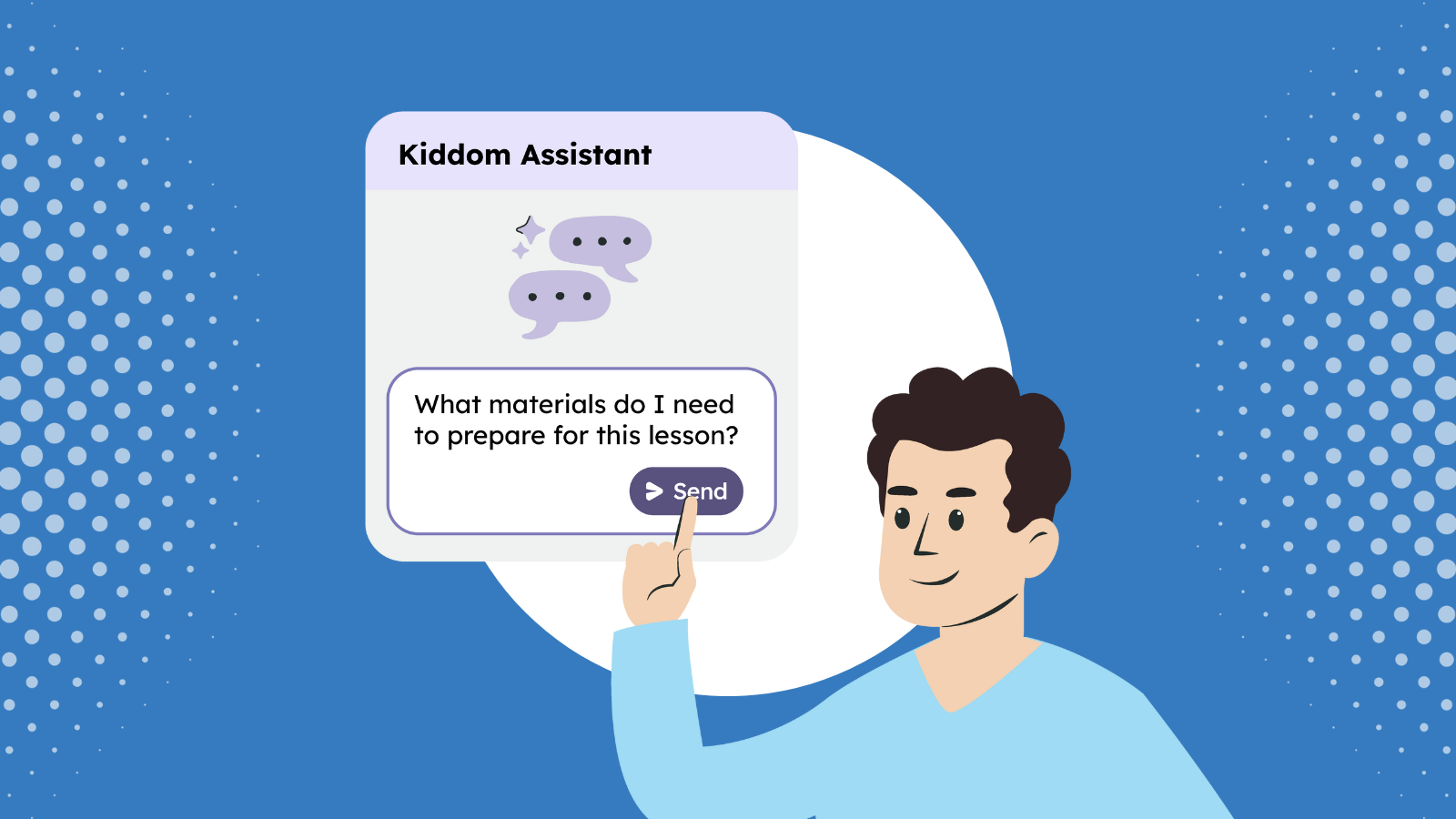
There is a second difference. A generator can produce a check for understanding in seconds, but you still have to decide what the results mean. Kiddom Math lessons carry that part too. The teacher notes say what to listen for while students work, and each cool-down says whether to keep going or slow down. When you want an extra check, Kiddom Assistant can generate a quiz from the lesson you're teaching, at one of three difficulty levels. Here's how to build one from your lesson.
Here is where evidence shows up across a single Kiddom Math unit, and what each piece is for. Most of it is formative by design. Only the unit assessments are summative, and even those can tell you what to revisit.
Formative checks across one Kiddom Math unit
Shows which earlier skills students will need support with, and whether the class can move faster. The guidance is to address those skills inside grade-level work, in warm-ups and activity launches.
Teacher notes name the thinking to listen for while students work, so you can respond with a question in the moment.
About five minutes, done on their own, aimed at the day's learning goal. Each one is marked More Chances, Points to Emphasize, or Press Pause.
One to three problems on the section's goals, with the same three kinds of next-step guidance.
Summative, with rubrics for constructed responses. Grades 6 to 8 have A and B forms of each end-of-unit assessment.
Practice problems in every lesson add a lighter check, in class or at home, with review of earlier lessons mixed in.
Take Grade 7, Unit 2, Lesson 7, “Comparing Relationships with Tables.” Students are learning to decide from a table whether a relationship could be proportional. The warm-up asks them to adjust a lemonade recipe so it tastes the same, a quick read on whether they reach for equivalent ratios.
The first activity is where the richest evidence shows up. Entrance to a state park costs $6 per vehicle plus $2 per person. Students fill in the total cost for 2, 4, and 10 people, then work out what each person pays.
The teacher notes flag one table to watch for. Some students treat the first answer as a rate and scale it up: $10 for two people becomes $20 for four and $50 for ten. In that table, everyone pays $5, so the relationship looks proportional. It isn't.
Two tables you might see during Activity 1
Entrance to a state park costs $6 per vehicle, plus $2 per person in the vehicle. How much would it cost for a car with 2 people? 4 people? 10 people?
| people | total cost | cost per person |
|---|---|---|
| 2 | $10 | $5.00 |
| 4 | $14 | $3.50 |
| 10 | $26 | $2.60 |
The $6 vehicle fee is paid once, so the cost per person drops as more people ride. The rows don't share a unit rate.
| people | total cost | cost per person |
|---|---|---|
| 2 | $10 | $5.00 |
| 4 | $20 | $5.00 |
| 10 | $50 | $5.00 |
Scaling up the first answer charges the vehicle fee again for every two people. The unit rate looks constant only because of that error. One question usually fixes it: did you count the car once?
This is formative assessment at its most useful. You see the thinking while students are still working, and the fix is a question, not a reteach. The activity's next question, what a bus of 50 people would pay, is there to show students they can't just scale up from a smaller case. The second activity raises the bar again: a few rows of data can show that a relationship is not proportional, but they can't prove that it is.
The lesson ends with a five-minute cool-down called “Apples and Pizza.” Students decide whether each table shows a proportional relationship, then write an equation for the one that does.
Lesson 7 cool-down: Apples and Pizza
Is the cost of the apples proportional to the weight of apples?
| pounds of apples | cost of apples |
|---|---|
| 2 | $3.76 |
| 3 | $5.64 |
| 4 | $7.52 |
| 5 | $9.40 |
Yes. Every row works out to $1.88 per pound, so c = 1.88p.
Is the cost of the pizza proportional to the number of toppings?
| number of toppings | cost of pizza |
|---|---|
| 2 | $11.99 |
| 3 | $13.49 |
| 4 | $14.99 |
| 5 | $16.49 |
No. The cost per topping changes from row to row, from about $6.00 to about $3.30.
The label is the part teachers tend to skip, and it may be the most useful thing on the page. This cool-down is marked More Chances. In the curriculum's words, “There is no need to slow down or add additional work to the next lessons.”
That is formative assessment working in both directions. Sometimes the evidence says stop. Just as often, it says the idea comes back in the next lesson, so a few wrong answers today are not a reason to rebuild tomorrow. A Points to Emphasize cool-down suggests small moves, like inviting more students to share a strategy or reviewing one practice problem together. A Press Pause cool-down is the one that may call for an optional activity or a return to earlier content.
For a step-by-step look at sorting cool-down responses into next-day groups, see what to do with exit ticket data tomorrow.
Section checkpoints are short, one to three problems, and they arrive before the end of the unit, while there is still time to act. They come with the same three kinds of guidance as cool-downs, so a checkpoint can tell you to keep moving as clearly as it can tell you to pause.
Unit assessments are summative, but how you use them is up to you. Constructed-response questions come with rubrics, three levels for shorter responses and four for extended ones, so a score comes with a description of what the student showed. You can turn on Show Work for any question so students explain or draw their reasoning. And in grades 6 to 8, the A and B forms of each end-of-unit assessment give you a second version when a student needs another try.
Formative assessment only helps if you can look at the evidence before the next class. Kiddom handles the collecting and sorting, so your time goes to the decision.
Scored as students submit. Multiple choice, multiple select, and other selected-response questions are scored as soon as students turn them in. Open responses, drawings, and graphs come to you to review.
Paper counts too. If your class does cool-downs on paper, Paper Score lets you upload photos or a PDF of the completed work. Kiddom scores the answers it can, flags anything that needs your eyes, and you post grades when you're ready. Scores sit in the gradebook next to digital work.
Results by standard. Questions on unit assessments carry their standards alignment, so results roll up into class and student mastery reports by standard.
Edit before you assign. You can change or add questions before assigning, choosing from 15 question types, and adjust which standards each question is tagged to.
Feedback with you in charge. In grades 3 to 12, AI-Feedback, part of Kiddom's Learning Intelligence Technology, drafts feedback on student work, and you decide what goes out. More in the faster students get feedback, the more they grow.
Formative assessment in math is checking what students understand during a unit, while there is still time to adjust teaching. It includes warm-ups, questions you ask during activities, exit tickets or cool-downs, and short quizzes. What makes it formative is that the results change what happens next, not whether it is graded.
The most useful tool is often the curriculum you already teach, because its questions are written for that unit and come with guidance for what to do next. Standalone quiz and polling tools collect answers quickly but don't know your scope and sequence. Kiddom Math builds readiness checks, daily cool-downs, section checkpoints, and unit assessments into every unit, and scores selected-response answers as students submit.
Kiddom Math does, in Kiddom IM® v.360 and in state editions such as Kiddom Florida Math and Kiddom Texas Math. Each includes a readiness check before each unit, a cool-down at the end of nearly every lesson, section checkpoints, and mid-unit and end-of-unit assessments. Each cool-down and checkpoint is marked More Chances, Points to Emphasize, or Press Pause to suggest a next step. Results from unit assessments roll up by standard.
Yes, when it supports the teacher's decision instead of replacing it. AI can draft feedback on open responses or suggest scores against a rubric for a teacher to review. In Kiddom, AI-Feedback drafts feedback on math work in grades 3 to 12, and the teacher controls what students see. The questions themselves come from the curriculum, not a generator.
Sort responses by the reasoning behind them, not just by score, then choose the smallest move that addresses it: a question during the next activity, a practice problem reviewed together, or time with a small group. In Kiddom Math, each cool-down says whether students will see the idea again soon or whether to slow down, which helps you size that move.
Every lesson, in small ways. Kiddom Math builds in a warm-up and activities to listen in on, a five-minute cool-down at the end of nearly every lesson, and a checkpoint at the end of each section. That gives you a daily signal without adding a separate quiz.
A cool-down plays the role of an exit ticket. It is a short task students do on their own at the end of a lesson, aimed at that day's learning goal. In Kiddom Math, each cool-down also comes with guidance on whether to keep going, make a small adjustment, or pause.
Research and practice
More from Kiddom
You don't need a new tool to do formative assessment well in math. You need questions that reveal thinking, a moment to look at the answers, and a clear next step. Kiddom Math puts all three into every lesson and leaves the decision with you.